Advertisements
Advertisements
प्रश्न
Is it possible to add two vectors of unequal magnitudes and get zero? Is it possible to add three vectors of equal magnitudes and get zero?
Advertisements
उत्तर
No, it is not possible to obtain zero by adding two vectors of unequal magnitudes.
Example: Let us add two vectors \[\vec{A}\] and \[\vec{B}\] of unequal magnitudes acting in opposite directions. The resultant vector is given by
\[R = \sqrt{A^2 + B^2 + 2AB\cos\theta}\]
If two vectors are exactly opposite to each other, then
\[\theta = 180^\circ, \cos180^\circ= - 1\]
\[R = \sqrt{A^2 + B^2 - 2AB}\]
\[ \Rightarrow R = \sqrt{\left( A - B \right)^2}\]
\[ \Rightarrow R = \left( A - B \right) \text { or } \left( B - A \right)\]
Yes, it is possible to add three vectors of equal magnitudes and get zero.
Lets take three vectors of equal magnitudes
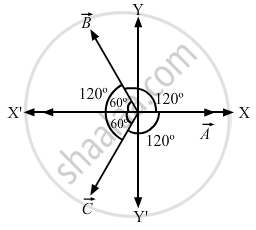
\[A_x = A\]
\[ A_y = 0\]
\[ B_x = - B \cos 60^\circ\]
\[ B_y = B \sin 60^\circ\]
\[ C_x = - C \cos 60^\circ\]
\[ C_y = - C \sin 60^\circ\]
\[\text { Here, A = B = C }\]
So, along the x - axis , we have:
\[A - (2A \cos 60^\circ) = 0, as \cos 60^\circ = \frac{1}{2} \]
\[ \Rightarrow B \sin 60^\circ - C \sin 60^\circ = 0\]
Hence, proved.
APPEARS IN
संबंधित प्रश्न
Some of the most profound statements on the nature of science have come from Albert Einstein, one of the greatest scientists of all time. What do you think did Einstein mean when he said : “The most incomprehensible thing about the world is that it is comprehensible”?
Suggest a way to measure the thickness of a sheet of paper.
Choose the correct statements(s):
(a) All quantities may be represented dimensionally in terms of the base quantities.
(b) A base quantity cannot be represented dimensionally in terms of the rest of the base quantities.
(c) The dimensions of a base quantity in other base quantities is always zero.
(d) The dimension of a derived quantity is never zero in any base quantity.
Theory of relativity reveals that mass can be converted into energy. The energy E so obtained is proportional to certain powers of mass m and the speed c of light. Guess a relation among the quantities using the method of dimensions.
Let I = current through a conductor, R = its resistance and V = potential difference across its ends. According to Ohm's law, product of two of these quantities equals the third. Obtain Ohm's law from dimensional analysis. Dimensional formulae for R and V are \[{\text{ML}}^2 \text{I}^{- 2} \text{T}^{- 3}\] and \[{\text{ML}}^2 \text{T}^{- 3} \text{I}^{- 1}\] respectively.
Let ε1 and ε2 be the angles made by \[\vec{A}\] and -\[\vec{A}\] with the positive X-axis. Show that tan ε1 = tan ε2. Thus, giving tan ε does not uniquely determine the direction of \[\vec{A}\].
Can you have \[\vec{A} \times \vec{B} = \vec{A} \cdot \vec{B}\] with A ≠ 0 and B ≠ 0 ? What if one of the two vectors is zero?
A vector is not changed if
Which of the sets given below may represent the magnitudes of three vectors adding to zero?
The radius of a circle is stated as 2.12 cm. Its area should be written as
Let \[\vec{C} = \vec{A} + \vec{B}\]
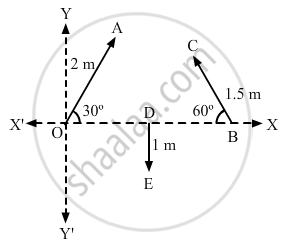
Refer to figure (2 − E1). Find (a) the magnitude, (b) x and y component and (c) the angle with the X-axis of the resultant of \[\overrightarrow{OA}, \overrightarrow{BC} \text { and } \overrightarrow{DE}\].
Two vectors have magnitudes 2 unit and 4 unit respectively. What should be the angle between them if the magnitude of the resultant is (a) 1 unit, (b) 5 unit and (c) 7 unit.
A mosquito net over a 7 ft × 4 ft bed is 3 ft high. The net has a hole at one corner of the bed through which a mosquito enters the net. It flies and sits at the diagonally opposite upper corner of the net. (a) Find the magnitude of the displacement of the mosquito. (b) Taking the hole as the origin, the length of the bed as the X-axis, it width as the Y axis, and vertically up as the Z-axis, write the components of the displacement vector.
Two vectors have magnitudes 2 m and 3m. The angle between them is 60°. Find (a) the scalar product of the two vectors, (b) the magnitude of their vector product.
If \[\vec{A} = 2 \vec{i} + 3 \vec{j} + 4 \vec{k} \text { and } \vec{B} = 4 \vec{i} + 3 \vec{j} + 2 \vec{k}\] find \[\vec{A} \times \vec{B}\].
Draw a graph from the following data. Draw tangents at x = 2, 4, 6 and 8. Find the slopes of these tangents. Verify that the curve draw is y = 2x2 and the slope of tangent is \[\tan \theta = \frac{dy}{dx} = 4x\]
\[\begin{array}x & 1 & 2 & 3 & 4 & 5 & 6 & 7 & 8 & 9 & 10 \\ y & 2 & 8 & 18 & 32 & 50 & 72 & 98 & 128 & 162 & 200\end{array}\]
The changes in a function y and the independent variable x are related as
\[\frac{dy}{dx} = x^2\] . Find y as a function of x.
High speed moving particles are studied under
