Advertisements
Advertisements
Question
Is it possible to add two vectors of unequal magnitudes and get zero? Is it possible to add three vectors of equal magnitudes and get zero?
Advertisements
Solution
No, it is not possible to obtain zero by adding two vectors of unequal magnitudes.
Example: Let us add two vectors \[\vec{A}\] and \[\vec{B}\] of unequal magnitudes acting in opposite directions. The resultant vector is given by
\[R = \sqrt{A^2 + B^2 + 2AB\cos\theta}\]
If two vectors are exactly opposite to each other, then
\[\theta = 180^\circ, \cos180^\circ= - 1\]
\[R = \sqrt{A^2 + B^2 - 2AB}\]
\[ \Rightarrow R = \sqrt{\left( A - B \right)^2}\]
\[ \Rightarrow R = \left( A - B \right) \text { or } \left( B - A \right)\]
Yes, it is possible to add three vectors of equal magnitudes and get zero.
Lets take three vectors of equal magnitudes
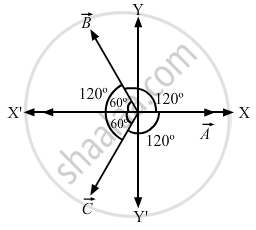
\[A_x = A\]
\[ A_y = 0\]
\[ B_x = - B \cos 60^\circ\]
\[ B_y = B \sin 60^\circ\]
\[ C_x = - C \cos 60^\circ\]
\[ C_y = - C \sin 60^\circ\]
\[\text { Here, A = B = C }\]
So, along the x - axis , we have:
\[A - (2A \cos 60^\circ) = 0, as \cos 60^\circ = \frac{1}{2} \]
\[ \Rightarrow B \sin 60^\circ - C \sin 60^\circ = 0\]
Hence, proved.
APPEARS IN
RELATED QUESTIONS
Some of the most profound statements on the nature of science have come from Albert Einstein, one of the greatest scientists of all time. What do you think did Einstein mean when he said : “The most incomprehensible thing about the world is that it is comprehensible”?
“Every great physical theory starts as a heresy and ends as a dogma”. Give some examples from the history of science of the validity of this incisive remark
What are the dimensions of volume of a cube of edge a.
What are the dimensions of the ratio of the volume of a cube of edge a to the volume of a sphere of radius a?
If two quantities have same dimensions, do they represent same physical content?
It is desirable that the standards of units be easily available, invariable, indestructible and easily reproducible. If we use foot of a person as a standard unit of length, which of the above features are present and which are not?
Suggest a way to measure the thickness of a sheet of paper.
Suppose a quantity x can be dimensionally represented in terms of M, L and T, that is, `[ x ] = M^a L^b T^c`. The quantity mass
A unitless quantity
Find the dimensions of linear momentum .
Find the dimensions of frequency .
Find the dimensions of magnetic field B.
The relevant equation are \[F = qE, F = qvB, \text{ and }B = \frac{\mu_0 I}{2 \pi a};\]
where F is force, q is charge, v is speed, I is current, and a is distance.
The height of mercury column in a barometer in a Calcutta laboratory was recorded to be 75 cm. Calculate this pressure in SI and CGS units using the following data : Specific gravity of mercury = \[13 \cdot 6\] , Density of \[\text{ water} = {10}^3 kg/ m^3 , g = 9 \cdot 8 m/ s^2\] at Calcutta. Pressure
= hpg in usual symbols.
A vector is not changed if
The resultant of \[\vec{A} \text { and } \vec{B}\] makes an angle α with \[\vec{A}\] and β with \[\vec{B}\],
The component of a vector is
The x-component of the resultant of several vectors
(a) is equal to the sum of the x-components of the vectors of the vectors
(b) may be smaller than the sum of the magnitudes of the vectors
(c) may be greater than the sum of the magnitudes of the vectors
(d) may be equal to the sum of the magnitudes of the vectors.
Let \[\vec{A} \text { and } \vec{B}\] be the two vectors of magnitude 10 unit each. If they are inclined to the X-axis at angle 30° and 60° respectively, find the resultant.
Round the following numbers to 2 significant digits.
(a) 3472, (b) 84.16. (c)2.55 and (d) 28.5
High speed moving particles are studied under
