Advertisements
Advertisements
प्रश्न
Is it possible to add two vectors of unequal magnitudes and get zero? Is it possible to add three vectors of equal magnitudes and get zero?
Advertisements
उत्तर
No, it is not possible to obtain zero by adding two vectors of unequal magnitudes.
Example: Let us add two vectors \[\vec{A}\] and \[\vec{B}\] of unequal magnitudes acting in opposite directions. The resultant vector is given by
\[R = \sqrt{A^2 + B^2 + 2AB\cos\theta}\]
If two vectors are exactly opposite to each other, then
\[\theta = 180^\circ, \cos180^\circ= - 1\]
\[R = \sqrt{A^2 + B^2 - 2AB}\]
\[ \Rightarrow R = \sqrt{\left( A - B \right)^2}\]
\[ \Rightarrow R = \left( A - B \right) \text { or } \left( B - A \right)\]
Yes, it is possible to add three vectors of equal magnitudes and get zero.
Lets take three vectors of equal magnitudes
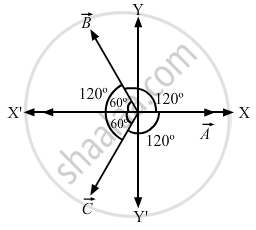
\[A_x = A\]
\[ A_y = 0\]
\[ B_x = - B \cos 60^\circ\]
\[ B_y = B \sin 60^\circ\]
\[ C_x = - C \cos 60^\circ\]
\[ C_y = - C \sin 60^\circ\]
\[\text { Here, A = B = C }\]
So, along the x - axis , we have:
\[A - (2A \cos 60^\circ) = 0, as \cos 60^\circ = \frac{1}{2} \]
\[ \Rightarrow B \sin 60^\circ - C \sin 60^\circ = 0\]
Hence, proved.
APPEARS IN
संबंधित प्रश्न
“Politics is the art of the possible”. Similarly, “Science is the art of the soluble”. Explain this beautiful aphorism on the nature and practice of science.
If two quantities have same dimensions, do they represent same physical content?
A physical quantity is measured and the result is expressed as nu where u is the unit used and n is the numerical value. If the result is expressed in various units then
Suppose a quantity x can be dimensionally represented in terms of M, L and T, that is, `[ x ] = M^a L^b T^c`. The quantity mass
Find the dimensions of the coefficient of linear expansion α and
Let x and a stand for distance. Is
\[\int\frac{dx}{\sqrt{a^2 - x^2}} = \frac{1}{a} \sin^{- 1} \frac{a}{x}\] dimensionally correct?
A vector is not changed if
A vector \[\vec{A}\] points vertically upward and \[\vec{B}\] points towards the north. The vector product \[\vec{A} \times \vec{B}\] is
The magnitude of the vector product of two vectors \[\left| \vec{A} \right|\] and \[\left| \vec{B} \right|\] may be
(a) greater than AB
(b) equal to AB
(c) less than AB
(d) equal to zero.
Add vectors \[\vec{A} , \vec{B} \text { and } \vec{C}\] each having magnitude of 100 unit and inclined to the X-axis at angles 45°, 135° and 315° respectively.
Let \[\vec{a} = 4 \vec{i} + 3 \vec{j} \text { and } \vec{b} = 3 \vec{i} + 4 \vec{j}\]. Find the magnitudes of (a) \[\vec{a}\] , (b) \[\vec{b}\] ,(c) \[\vec{a} + \vec{b} \text { and }\] (d) \[\vec{a} - \vec{b}\].
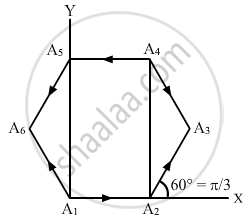
Let A1 A2 A3 A4 A5 A6 A1 be a regular hexagon. Write the x-components of the vectors represented by the six sides taken in order. Use the fact the resultant of these six vectors is zero, to prove that
cos 0 + cos π/3 + cos 2π/3 + cos 3π/3 + cos 4π/3 + cos 5π/3 = 0.
Use the known cosine values to verify the result.
Let \[\vec{a} = 2 \vec{i} + 3 \vec{j} + 4 \vec{k} \text { and } \vec{b} = 3 \vec{i} + 4 \vec{j} + 5 \vec{k}\] Find the angle between them.
The electric current in a charging R−C circuit is given by i = i0 e−t/RC where i0, R and C are constant parameters of the circuit and t is time. Find the rate of change of current at (a) t = 0, (b) t = RC, (c) t = 10 RC.
The changes in a function y and the independent variable x are related as
\[\frac{dy}{dx} = x^2\] . Find y as a function of x.
In a submarine equipped with sonar, the time delay between the generation of a pulse and its echo after reflection from an enemy submarine is observed to be 80 s. If the speed of sound in water is 1460 ms-1. What is the distance of an enemy submarine?
Jupiter is at a distance of 824.7 million km from the Earth. Its angular diameter is measured to be 35.72˝. Calculate the diameter of Jupiter.
If π = 3.14, then the value of π2 is ______
High speed moving particles are studied under
