Advertisements
Advertisements
प्रश्न
Two vectors have magnitudes 2 unit and 4 unit respectively. What should be the angle between them if the magnitude of the resultant is (a) 1 unit, (b) 5 unit and (c) 7 unit.
Advertisements
उत्तर
Let the two vectors be \[\vec{a}\] and \[\vec{b}\]
Now,
\[\left| \vec{a} \right| = 3 \text { and } \left| \vec{b} \right| = 4\]
\[\sqrt{\vec{a}^2 + \vec{b}^2 + 2 . \vec{a} . \vec{b} \cos \theta} = 1\]
\[ \Rightarrow \sqrt{3^2 + 4^2 + 2 . 3 . 4 \cos \theta} = 1\]
Squaring both sides, we get:
\[25 + 24 \cos \theta = 1\]
\[ \Rightarrow 24 \cos \theta = - 24\]
\[ \Rightarrow \cos \theta = - 1\]
\[ \Rightarrow \theta = 180^\circ\]
Hence, the angle between them is 180°.
(b) If the resultant vector is 5 units, then
\[\sqrt{\vec{a}^2 + \vec{b}^2 + 2 . \vec{a} . \vec{b} \cos \theta} = 5\]
\[ \Rightarrow \sqrt{3^2 + 4^2 + 2 . 3 . 4 \cos \theta} = 5\]
Squaring both sides, we get:
25 + 24 cos θ = 25
⇒ 24 cos θ = 0
⇒ cos θ = 90°
Hence, the angle between them is 90°.
(c) If the resultant vector is 7 units, then
\[\sqrt{\vec{a}^2 + \vec{b}^2 + 2 . \vec{a} . \vec{b} \cos \theta} = 1\]
\[ \Rightarrow \sqrt{3^2 + 4^2 + 2 . 3 . 4 \cos \theta} = 7\]
Squaring both sides, we get:
25 + 24 cos θ = 49,
⇒ 24 cos θ = 24
⇒ cos θ = 1
⇒ θ = cos−1 1 = 0°
Hence, the angle between them is 0°.
APPEARS IN
संबंधित प्रश्न
Find the dimensions of electric field E.
The relevant equations are \[F = qE, F = qvB, \text{ and }B = \frac{\mu_0 I}{2 \pi a};\]
where F is force, q is charge, v is speed, I is current, and a is distance.
Find the dimensions of magnetic field B.
The relevant equation are \[F = qE, F = qvB, \text{ and }B = \frac{\mu_0 I}{2 \pi a};\]
where F is force, q is charge, v is speed, I is current, and a is distance.
Find the dimensions of Planck's constant h from the equation E = hv where E is the energy and v is the frequency.
Theory of relativity reveals that mass can be converted into energy. The energy E so obtained is proportional to certain powers of mass m and the speed c of light. Guess a relation among the quantities using the method of dimensions.
Test if the following equation is dimensionally correct:
\[h = \frac{2S cos\theta}{\text{ prg }},\]
where h = height, S = surface tension, ρ = density, I = moment of interia.
Can you add three unit vectors to get a unit vector? Does your answer change if two unit vectors are along the coordinate axes?
Can you add two vectors representing physical quantities having different dimensions? Can you multiply two vectors representing physical quantities having different dimensions?
The radius of a circle is stated as 2.12 cm. Its area should be written as
The x-component of the resultant of several vectors
(a) is equal to the sum of the x-components of the vectors of the vectors
(b) may be smaller than the sum of the magnitudes of the vectors
(c) may be greater than the sum of the magnitudes of the vectors
(d) may be equal to the sum of the magnitudes of the vectors.
Let \[\vec{A} \text { and } \vec{B}\] be the two vectors of magnitude 10 unit each. If they are inclined to the X-axis at angle 30° and 60° respectively, find the resultant.
Add vectors \[\vec{A} , \vec{B} \text { and } \vec{C}\] each having magnitude of 100 unit and inclined to the X-axis at angles 45°, 135° and 315° respectively.
Let \[\vec{a} = 4 \vec{i} + 3 \vec{j} \text { and } \vec{b} = 3 \vec{i} + 4 \vec{j}\]. Find the magnitudes of (a) \[\vec{a}\] , (b) \[\vec{b}\] ,(c) \[\vec{a} + \vec{b} \text { and }\] (d) \[\vec{a} - \vec{b}\].
Two vectors have magnitudes 2 m and 3m. The angle between them is 60°. Find (a) the scalar product of the two vectors, (b) the magnitude of their vector product.
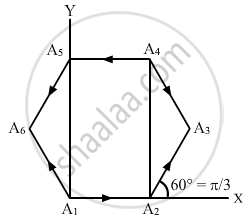
Let A1 A2 A3 A4 A5 A6 A1 be a regular hexagon. Write the x-components of the vectors represented by the six sides taken in order. Use the fact the resultant of these six vectors is zero, to prove that
cos 0 + cos π/3 + cos 2π/3 + cos 3π/3 + cos 4π/3 + cos 5π/3 = 0.
Use the known cosine values to verify the result.
Prove that \[\vec{A} . \left( \vec{A} \times \vec{B} \right) = 0\].
The electric current in a charging R−C circuit is given by i = i0 e−t/RC where i0, R and C are constant parameters of the circuit and t is time. Find the rate of change of current at (a) t = 0, (b) t = RC, (c) t = 10 RC.
If π = 3.14, then the value of π2 is ______
High speed moving particles are studied under
