Advertisements
Advertisements
प्रश्न
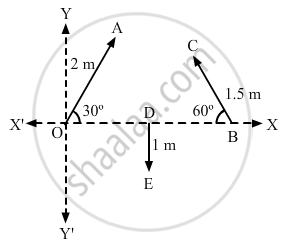
Refer to figure (2 − E1). Find (a) the magnitude, (b) x and y component and (c) the angle with the X-axis of the resultant of \[\overrightarrow{OA}, \overrightarrow{BC} \text { and } \overrightarrow{DE}\].
Advertisements
उत्तर
First, let us find the components of the vectors along the x and y-axes. Then we will find the resultant x and y-components.
x-component of \[\overrightarrow{OA} = 2 \cos 30^\circ= \sqrt{3}\]
x-component of \[\overrightarrow{BC}\] = 1.5 cos120°
\[= - \frac{\left( 1 . 5 \right)}{2} = - 7 . 5\]
x-component of \[\overrightarrow{DE}\] = 1 cos 270°
= 1 × 0 = 0 m
y-component of \[\overrightarrow {OA}\] = 2 sin 30° = 1
y-component of \[\overrightarrow{BC}\] = 1.5 sin 120°
\[= \frac{\left( \sqrt{3} \times 1 . 5 \right)}{2} = 1 . 3\]
y-component of \[\overrightarrow{DE}\] = 1 sin 270° = −1
x-component of resultant \[R_x = \sqrt{3} - 0 . 75 + 0 = 0 . 98 m\]
y-component of resultant Ry = 1 + 1.3 − 1 = 1.3 m
\[\therefore \text { Resultant, R }= \sqrt{\left( R_x \right)^2 + \left( R_y \right)^2}\]
\[ = \sqrt{\left( 0 . 98 \right)^2 + \left( 1 . 3 \right)^2}\]
\[ = \sqrt{0 . 96 + 1 . 69}\]
\[ = \sqrt{2 . 65}\]
\[ = 1 . 6 m\]
If it makes an angle α with the positive x-axis, then
\[\tan \alpha = \frac{\text { y -component }}{\text { x - component }}\]
\[ = \frac{1 . 3}{0 . 98} = 1 . 332\]
APPEARS IN
संबंधित प्रश्न
“Politics is the art of the possible”. Similarly, “Science is the art of the soluble”. Explain this beautiful aphorism on the nature and practice of science.
If all the terms in an equation have same units, is it necessary that they have same dimensions? If all the terms in an equation have same dimensions, is it necessary that they have same units?
Find the dimensions of frequency .
Find the dimensions of the coefficient of linear expansion α and
Let I = current through a conductor, R = its resistance and V = potential difference across its ends. According to Ohm's law, product of two of these quantities equals the third. Obtain Ohm's law from dimensional analysis. Dimensional formulae for R and V are \[{\text{ML}}^2 \text{I}^{- 2} \text{T}^{- 3}\] and \[{\text{ML}}^2 \text{T}^{- 3} \text{I}^{- 1}\] respectively.
Can you add two vectors representing physical quantities having different dimensions? Can you multiply two vectors representing physical quantities having different dimensions?
Can a vector have zero component along a line and still have nonzero magnitude?
Can you have \[\vec{A} \times \vec{B} = \vec{A} \cdot \vec{B}\] with A ≠ 0 and B ≠ 0 ? What if one of the two vectors is zero?
A vector is not changed if
A vector \[\vec{A}\] points vertically upward and \[\vec{B}\] points towards the north. The vector product \[\vec{A} \times \vec{B}\] is
Let \[\vec{C} = \vec{A} + \vec{B}\]
A mosquito net over a 7 ft × 4 ft bed is 3 ft high. The net has a hole at one corner of the bed through which a mosquito enters the net. It flies and sits at the diagonally opposite upper corner of the net. (a) Find the magnitude of the displacement of the mosquito. (b) Taking the hole as the origin, the length of the bed as the X-axis, it width as the Y axis, and vertically up as the Z-axis, write the components of the displacement vector.
Two vectors have magnitudes 2 m and 3m. The angle between them is 60°. Find (a) the scalar product of the two vectors, (b) the magnitude of their vector product.
The electric current in a charging R−C circuit is given by i = i0 e−t/RC where i0, R and C are constant parameters of the circuit and t is time. Find the rate of change of current at (a) t = 0, (b) t = RC, (c) t = 10 RC.
The changes in a function y and the independent variable x are related as
\[\frac{dy}{dx} = x^2\] . Find y as a function of x.
Write the number of significant digits in (a) 1001, (b) 100.1, (c) 100.10, (d) 0.001001.
High speed moving particles are studied under
