Advertisements
Advertisements
प्रश्न
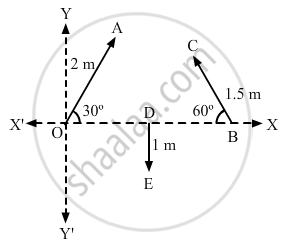
Refer to figure (2 − E1). Find (a) the magnitude, (b) x and y component and (c) the angle with the X-axis of the resultant of \[\overrightarrow{OA}, \overrightarrow{BC} \text { and } \overrightarrow{DE}\].
Advertisements
उत्तर
First, let us find the components of the vectors along the x and y-axes. Then we will find the resultant x and y-components.
x-component of \[\overrightarrow{OA} = 2 \cos 30^\circ= \sqrt{3}\]
x-component of \[\overrightarrow{BC}\] = 1.5 cos120°
\[= - \frac{\left( 1 . 5 \right)}{2} = - 7 . 5\]
x-component of \[\overrightarrow{DE}\] = 1 cos 270°
= 1 × 0 = 0 m
y-component of \[\overrightarrow {OA}\] = 2 sin 30° = 1
y-component of \[\overrightarrow{BC}\] = 1.5 sin 120°
\[= \frac{\left( \sqrt{3} \times 1 . 5 \right)}{2} = 1 . 3\]
y-component of \[\overrightarrow{DE}\] = 1 sin 270° = −1
x-component of resultant \[R_x = \sqrt{3} - 0 . 75 + 0 = 0 . 98 m\]
y-component of resultant Ry = 1 + 1.3 − 1 = 1.3 m
\[\therefore \text { Resultant, R }= \sqrt{\left( R_x \right)^2 + \left( R_y \right)^2}\]
\[ = \sqrt{\left( 0 . 98 \right)^2 + \left( 1 . 3 \right)^2}\]
\[ = \sqrt{0 . 96 + 1 . 69}\]
\[ = \sqrt{2 . 65}\]
\[ = 1 . 6 m\]
If it makes an angle α with the positive x-axis, then
\[\tan \alpha = \frac{\text { y -component }}{\text { x - component }}\]
\[ = \frac{1 . 3}{0 . 98} = 1 . 332\]
APPEARS IN
संबंधित प्रश्न
“It is more important to have beauty in the equations of physics than to have them agree with experiments”. The great British physicist P. A. M. Dirac held this view. Criticize this statement. Look out for some equations and results in this book which strike you as beautiful.
It is desirable that the standards of units be easily available, invariable, indestructible and easily reproducible. If we use foot of a person as a standard unit of length, which of the above features are present and which are not?
A physical quantity is measured and the result is expressed as nu where u is the unit used and n is the numerical value. If the result is expressed in various units then
A unitless quantity
The dimensions ML−1 T−2 may correspond to
Choose the correct statements(s):
Find the dimensions of linear momentum .
Find the dimensions of pressure.
Test if the following equation is dimensionally correct:
\[v = \sqrt{\frac{P}{\rho}},\]
where v = velocity, ρ = density, P = pressure
Can you add two vectors representing physical quantities having different dimensions? Can you multiply two vectors representing physical quantities having different dimensions?
Can a vector have zero component along a line and still have nonzero magnitude?
A vector \[\vec{A}\] makes an angle of 20° and \[\vec{B}\] makes an angle of 110° with the X-axis. The magnitudes of these vectors are 3 m and 4 m respectively. Find the resultant.
Two vectors have magnitudes 2 m and 3m. The angle between them is 60°. Find (a) the scalar product of the two vectors, (b) the magnitude of their vector product.
Let \[\vec{a} = 2 \vec{i} + 3 \vec{j} + 4 \vec{k} \text { and } \vec{b} = 3 \vec{i} + 4 \vec{j} + 5 \vec{k}\] Find the angle between them.
Prove that \[\vec{A} . \left( \vec{A} \times \vec{B} \right) = 0\].
A curve is represented by y = sin x. If x is changed from \[\frac{\pi}{3}\text{ to }\frac{\pi}{3} + \frac{\pi}{100}\] , find approximately the change in y.
In a submarine equipped with sonar, the time delay between the generation of a pulse and its echo after reflection from an enemy submarine is observed to be 80 s. If the speed of sound in water is 1460 ms-1. What is the distance of an enemy submarine?
High speed moving particles are studied under
