Advertisements
Advertisements
Question
Let A = ℝ − {3}, B = ℝ − {1}. Let f : A → B be defined by \[f\left( x \right) = \frac{x - 2}{x - 3}, \forall x \in A\] Show that f is bijective. Also, find
(i) x, if f−1(x) = 4
(ii) f−1(7)
Advertisements
Solution
We have,
A = R \[-\] {3} and B = R \[-\] {1}
The function f : A \[\to\] B defined by f(x) = \[\frac{x - 2}{x - 3}\]
\[\text { Let }x, y \text { in A such that }f\left( x \right) = f\left( y \right) . \text { Then }, \]
\[\frac{x - 2}{x - 3} = \frac{y - 2}{y - 3}\]
\[ \Rightarrow xy - 3x - 2y + 6 = xy - 2x - 3y + 6\]
\[ \Rightarrow - x = - y\]
\[ \Rightarrow x = y\]
\[ \therefore\text { f is one - one } .\]
\[\text { Let y } \in B . \text { Then, y } \neq 1 . \]
\[\text { The function f is onto if there exists } x \text { in A such that f }\left( x \right) = y . \]
\[\text {Now,}\]
\[f\left( x \right) = y\]
\[ \Rightarrow \frac{x - 2}{x - 3} = y\]
\[ \Rightarrow x - 2 = xy - 3y\]
\[ \Rightarrow x - xy = 2 - 3y\]
\[ \Rightarrow x\left( 1 - y \right) = 2 - 3y\]
\[ \Rightarrow x = \frac{2 - 3y}{1 - y} \in A \left[ y \neq 1 \right]\]
\[\text { Thus, for any } y \text { in B, there exists } \frac{2 - 3y}{1 - y} \text { in A such that }\]
\[f\left( \frac{2 - 3y}{1 - y} \right) = \frac{\left( \frac{2 - 3y}{1 - y} \right) - 2}{\left( \frac{2 - 3y}{1 - y} \right) - 3} = \frac{2 - 3y - 2 + 2y}{2 - 3y - 3 + 3y} = \frac{- y}{- 1} = y\]
\[ \therefore \text { f is onto } .\]
\[\text { So, f is one - one and onto fucntion } . \]
\[\text { Now }, \]
\[\text { As,} x = \left( \frac{2 - 3y}{1 - y} \right)\]
\[\text { So }, f^{- 1} \left( x \right) = \left( \frac{2 - 3x}{1 - x} \right) = \frac{3x - 2}{x - 1}\]
Therefore,f is bijective.
(i) \[f^{- 1} \left( x \right) = 4\]
\[ \Rightarrow \frac{3x - 2}{x - 1} = 4\]
\[ \Rightarrow 3x - 2 = 4x - 4\]
\[ \Rightarrow x = 2\]
\[f^{- 1} \left( x \right) = \frac{3x - 2}{x - 1}\]
\[ \Rightarrow f^{- 1} \left( 7 \right) = \frac{3\left( 7 \right) - 2}{7 - 1} = \frac{19}{6}\]
APPEARS IN
RELATED QUESTIONS
Give an example of a function which is one-one but not onto ?
Classify the following function as injection, surjection or bijection :
f : R → R, defined by f(x) = x3 + 1
Let f : N → N be defined by
`f(n) = { (n+ 1, if n is odd),( n-1 , if n is even):}`
Show that f is a bijection.
[CBSE 2012, NCERT]
Find gof and fog when f : R → R and g : R → R is defined by f(x) = x2 + 8 and g(x) = 3x3 + 1 .
If f, g : R → R be two functions defined as f(x) = |x| + x and g(x) = |x|- x, ∀x∈R" .Then find fog and gof. Hence find fog(–3), fog(5) and gof (–2).
Find f −1 if it exists : f : A → B, where A = {1, 3, 5, 7, 9}; B = {0, 1, 9, 25, 49, 81} and f(x) = x2
Let A = R - {3} and B = R - {1}. Consider the function f : A → B defined by f(x) = `(x-2)/(x-3).`Show that f is one-one and onto and hence find f-1.
[CBSE 2012, 2014]
If f : R → (0, 2) defined by `f (x) =(e^x - e^(x))/(e^x +e^(-x))+1`is invertible , find f-1.
Let f be a function from R to R, such that f(x) = cos (x + 2). Is f invertible? Justify your answer.
Which of the following graphs represents a one-one function?
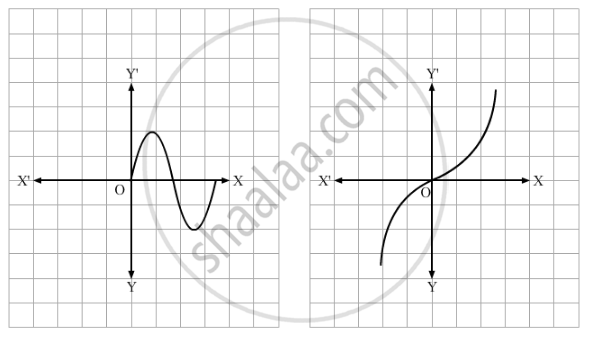
If f : R → R is given by f(x) = x3, write f−1 (1).
Let f be a function from C (set of all complex numbers) to itself given by f(x) = x3. Write f−1 (−1).
If f : C → C is defined by f(x) = x4, write f−1 (1).
If f : R → R is defined by f(x) = x2, find f−1 (−25).
If f : R → R, g : R → are given by f(x) = (x + 1)2 and g(x) = x2 + 1, then write the value of fog (−3).
Let \[f : \left[ - \frac{\pi}{2}, \frac{\pi}{2} \right] \to\] A be defined by f(x) = sin x. If f is a bijection, write set A.
The range of the function
\[f\left( x \right) =^{7 - x} P_{x - 3}\]
Let \[f\left( x \right) = \frac{1}{1 - x} . \text{Then}, \left\{ f o \left( fof \right) \right\} \left( x \right)\]
Let \[f\left(x\right) = x^3\] be a function with domain {0, 1, 2, 3}. Then domain of \[f^{-1}\] is ______.
Write about strlen() function.
Set A has 3 elements and the set B has 4 elements. Then the number of injective mappings that can be defined from A to B is ______.
Let A be a finite set. Then, each injective function from A into itself is not surjective.
Which of the following functions from Z into Z is bijective?
Let f : R → R be a function defined by f(x) `= ("e"^abs"x" - "e"^-"x")/("e"^"x" + "e"^-"x")` then f(x) is
Let f: R→R be a continuous function such that f(x) + f(x + 1) = 2, for all x ∈ R. If I1 = `int_0^8f(x)dx` and I2 = `int_(-1)^3f(x)dx`, then the value of I1 + 2I2 is equal to ______.
Let a and b are two positive integers such that b ≠ 1. Let g(a, b) = Number of lattice points inside the quadrilateral formed by lines x = 0, y = 0, x = b and y = a. f(a, b) = `[a/b] + [(2a)/b] + ... + [((b - 1)a)/b]`, then the value of `[(g(101, 37))/(f(101, 37))]` is ______.
(Note P(x, y) is lattice point if x, y ∈ I)
(where [.] denotes greatest integer function)
Let a function `f: N rightarrow N` be defined by
f(n) = `{:[(2n",", n = 2"," 4"," 6"," 8","......),(n - 1",", n = 3"," 7"," 11"," 15","......),((n + 1)/2",", n = 1"," 5"," 9"," 13","......):}`
then f is ______.
The function f(x) = [x], where [x] denotes the greatest integer less than or equal to x; is continuous at ______.
Let \(X=\{-1,2,5,8,11\}\), \(Y=\{4,6,8\}\), and suppose different elements \(2,5,8\) of \(X\) have the same image \(4\). What type of function is it with respect to the one-one property?
