Advertisements
Advertisements
Question
Instructions for Question: Read the information given below to answer the question.
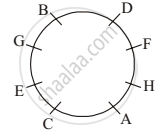
A, B, C, D, E, F, G, and H want to have dinner on a round table and they have worked out the following seating arrangements.
(a) A will sit beside C.
(b) H will sit beside A.
(c) C will sit beside E.
(d) F will sit beside H.
(e) E will sit beside G.
(f) D will sit beside F.
(g) G will sit beside B.
(h) B will sit beside D.
During sitting:
Options
A will be directly facing C
B will be directly facing C
A will be directly facing B
B will be directly facing D
Advertisements
Solution
A will be directly facing B
Explanation:
APPEARS IN
RELATED QUESTIONS
Read the following information for a question and chose the most appropriate option:
P and Q are good at driving the Motorcycle and Jeep. R and P are good at driving Jeep and Lorry. R, S, and T are good at driving Motor Cycle and Lorry. T and R are good at driving buses and Tempo. S and Q are good at driving Bus and Jeep.
Who is good at driving all the vehicles?
Choose the best option that correctly classifies the four sentences as a :
F: Fact: if it relates to a known matter of direct observation, or an existing reality or something known to be true
J: Judgment: If it is an opinion or estimate or anticipation of common sense or intention.
I: Inference: If it is a logical conclusion or deduction about something based:I on the knowledge of facts.
A. Everyday social life is impossible without interpersonal relationships.
B. The root of many misunderstandings has been cited in poor relations individuals.
C. Assuming the above to be true. social life will be much better if people understand the importance of good interpersonal relations.
D. A study reveals that interpersonal relations and hence life, in general, can be improved with a little effort on the part of individuals.
Read the information given below and answer the question that follows.
The faces of a cube are painted in different colors. Blackface is opposite to red. Whiteface is between black and red. Green face is adjacent to grey and blue face is adjacent to green. What colour will be on the face opposite to the white face of the cube?
Read the following information carefully and answer the question given below.
Seven film buffs - Aamna, Archana, Aradhana, Anu, Aahana, Anuja, and Aashna - attend a showing of classic movies. Three films are shown, one directed by Satyajit Ray, one by Stanley Kubrick, and one by Steven Spielberg. Each of the film buff see only one of the three films. The films are shown only once, one film at a time.
The following restrictions must apply:
- Exactly twice as many of the film buffs see the Stanley Kubrick film as the Satyajit Ray film.
- Aamna and Aahana do not see the same film as each other.
- Archana and Anu do not see the same film as each other.
- Anuja and Aashna see the same film as each other.
- Aradhana sees the Stanley Kubrick film.
- Aamna sees either the Satyajit Ray film or the Steven Spielberg film.
Which of the following must be true?
Read the following information carefully and answer the question given below.
Seven film buffs -Aamna, Archana, Aradhana, Anu, Aahana, Anuja, and Aashna - attend a showing of classic movies. Three films are shown, one directed by Satyajit Ray, one by Stanley Kubrick, and one by Steven Spielberg. Each of the film buff see only one of the three films. The films are shown only once, one film at a time.
The following restrictions must apply:
- Exactly twice as many of the film buffs see the Stanley Kubrick film as the Satyajit Ray film.
- Aamna and Aahana do not see the same film as each other.
- Archana and Anu do not see the same film as each other.
- Anuja and Aashna see the same film as each other.
- Aradhana sees the Stanley Kubrick film.
- Aamna sees either the Satyajit Ray film or the Steven Spielberg film.
Each of the following could be a complete and accurate list of the film buffs who see the Satyajit Ray film EXCEPT
In making a decision about an important question, it is desirable to distinguish between a 'strong' argument and a 'weak' argument. A 'strong' argument must be both important and directly related to the question. A 'weak' argument may not be directly related to the question and may be of minor importance or may be related to the trivial aspect of the question. The question below is followed by two arguments numbered I and II. You have to decide which of the arguments is 'strong' and which is 'weak'.
Statement
- Should English be the medium of instruction for higher education in India?
Arguments
- Yes, even in advanced countries like the UK and the USA, the medium of instruction is English for higher education.
- Yes, English is a much widely spoken language in the world today.
Read the following short passage and choose the best answer to the questions that follow each passage.
With social media emerging as one of the most popular hangouts for Indians, brand endorsement deals in the country are getting hugely influenced by how active celebrities are on Twitter, Facebook Instagram, and blogs.
Which of the following substantially weakens the argument given in the above statement?
The question below is given a statement followed by two assumptions numbered I and II. An assumption is something supposed or taken for granted. You have to consider the statement and the following assumptions and decide which of the assumptions is implicit in the statement.
Statement Unless country 'X' achieves total literacy, it cannot achieve its mission of development.
Assumptions
- It is possible to achieve total literacy in the country 'X'.
- No development is possible without a proper mission.
In the following question, two statements are given followed by two or three Conclusions I, II, and m. You have to consider the two statements to be true even if they seem to be at variance from commonly known facts. You have to decide which of the given conclusions if any follow from the given statements.
Statements
- Most of the 64 number of buses go to my office.
- This is the 64 number bus.
Conclusions
- This bus goes to my office.
- This bus does not go to my office.
The question below is given a statement followed by three courses of action numbered I, II, and ill. A course of action is a step or administrative decision to be taken for improvement, follow-up, or further action in regard to the problem, policy, etc. On the basis of information given in the statement, you have to assume everything in the statement to be true and then decide which of the three given suggested courses of action logically follows worth pursuing. Then, decide which of the alternatives (a), (b), (c), or (d) is correct.
Statement The police have failed to protect the elderly citizens of society. Only last week three old persons were killed at three different places.
Courses of Action
I. The police should be asked to take special care of women and children.
II. The Government should bring legislation against the killing of elderly people.
III. Criminals who are accused of killing elderly people should be prosecuted by the state.
