Advertisements
Advertisements
Question
Instructions for Question: Read the information given below to answer the question.
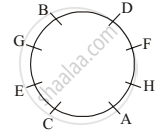
A, B, C, D, E, F, G, and H want to have dinner on a round table and they have worked out the following seating arrangements.
(a) A will sit beside C.
(b) H will sit beside A.
(c) C will sit beside E.
(d) F will sit beside H.
(e) E will sit beside G.
(f) D will sit beside F.
(g) G will sit beside B.
(h) B will sit beside D.
A and F will become neighbours if:
Options
B agrees to change her sitting position
C agrees to change her sitting position
G agrees to change her sitting position
H agrees to change her sitting position
Advertisements
Solution
H agrees to change her sitting position
Explanation:
APPEARS IN
RELATED QUESTIONS
Read the following information for a question and chose the most appropriate option:
P and Q are good at driving the Motorcycle and Jeep. R and P are good at driving Jeep and Lorry. R, S, and T are good at driving Motor Cycle and Lorry. T and R are good at driving buses and Tempo. S and Q are good at driving Bus and Jeep.
Who is good at a driving motorcycle, jeep, and Lorry but not a bus?
Answer the question based on the information given.
"Some men are certainly intelligent, others are certainly not intelligent, but of intermediate men, we should say, 'intelligent'? Yes, I think, so or no, I shouldn't be inclined to call him intelligent."
Which of the following most accurately reflects the intention of the writer of the above?
Find the odd one out of the following group.
Windshield, Spark plug, Clutch pedal, Car, Engine
Choose the most appropriate option:
Identify the statement which cannot be false.
Melt : Liquid :: Freeze : ?
In the following questions find which one word cannot be formed from the letters of the given words using each letter only once:
COMPENSATION
Read the following information carefully and answer the question given below.
Seven film buffs -Aamna, Archana, Aradhana, Anu, Aahana, Anuja, and Aashna - attend a showing of classic movies. Three films are shown, one directed by Satyajit Ray, one by Stanley Kubrick, and one by Steven Spielberg. Each of the film buff see only one of the three films. The films are shown only once, one film at a time.
The following restrictions must apply:
- Exactly twice as many of the film buffs see the Stanley Kubrick film as the Satyajit Ray film.
- Aamna and Aahana do not see the same film as each other.
- Archana and Anu do not see the same film as each other.
- Anuja and Aashna see the same film as each other.
- Aradhana sees the Stanley Kubrick film.
- Aamna sees either the Satyajit Ray film or the Steven Spielberg film.
Each of the following must be false EXCEPT
Read the following short passage and choose the best answer to the question below that passage.
The indigenous people of Tago are clearly related to the indigenous people of Taminia, but were separated from them when the land bridge between Taminia and Tago disappeared approximately 10,000 years ago. Two thousand years after the disappearance of the land bridge, however, there were major differences between the culture and technology of the indigenous Tagoians and those of the indigenous Taminians. The indigenous Tagoian unlike their Taminian relatives, had no domesticated dogs, fishing nets, polished stone tools, or hunting implements like the boomerang and the spear-thrower.
Each of the following, if true, would contribute to an explanation of differences described above EXCEPT
Political turmoil in a country is mainly caused by widespread violence and flawed economic policies of successive governments. If at all this has to be crushed, it can be achieved only by a dictatorial government which rules with iron hand. Therefore, the need of the hour is to elect a government which imposes fresh set of stringent legislations.
The alternatives suggested (not necessarily all), if true, significantly strengthen the argument. However, one of them is most forceful. Identify the same.
Cuisine from the North of China is one of the most popular kinds of food in India. But this is not the case for Southern Chinese cuisine. In fact, in a recent survey, Southern Chinese cuisine was voted one of the least popular styles of cooking in the country.
Which one of the following, if true, most helps to resolve the apparent paradox described above?
