Advertisements
Advertisements
Question
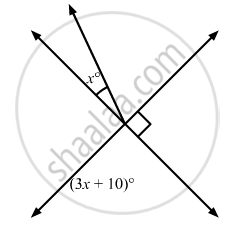
In the given figure, the value of x is ______.
Options
12
15
20
30
Advertisements
Solution
In the given figure, the value of x is 20.
Explanation:
The figure is as follows:

It is given that
∠2 = 90°
Also,
∠1 = (3x + 10)° ...(vertically opposite angles)
Since, x°, ∠1 and ∠2 form a linear pair.
Therefore,
x + ∠1 + ∠2 = 180°
x + (3x + 10°) + 90° = 180°
4x + 100° = 180°
4x = 180° -100°
4x = 80°
x = `(80°)/4`
x = 20°
APPEARS IN
RELATED QUESTIONS
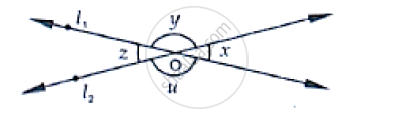
In the below fig, lines �1 and �2 intersect at O, forming angles as shown in the figure. If x = 45, Find the values of x, y, z and u.
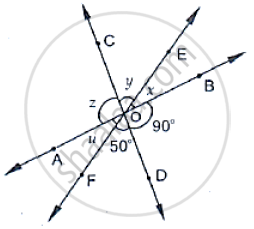
In the below fig, three coplanar lines intersect at a point O, forming angles as shown in the figure. Find the values of x, y, z and u.
If one of the four angles formed by two intersecting lines is a right angle, then show that
each of the four angles is a right angle.
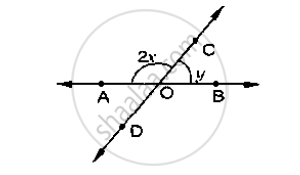
In the below fig, rays AB and CD intersect at O
Determine x when y =40
Two lines AB and CD intersect at O. If `∠`AOC + `∠`COB + `∠`BOD = 270°, find the
measures of `∠`AOC, `∠`COB, `∠`BOD and `∠`DOA.
Two straight line AB and CD intersect one another at the point O. If ∠AOC + ∠COB + ∠BOD = 274°, then ∠AOD =
Consider the following statements:
When two straight lines intersect:
(i) adjacent angles are complementary
(ii) adjacent angles are supplementary
(iii) opposite angles are equal
(iv) opposite angles are supplementary
Of these statements
Two lines AB and CD intersect at O. If ∠AOC + ∠COB + ∠BOD = 270°, then ∠AOC =
Two parallel lines meet each other at some point.
Two lines in a plane which do not meet at a point anywhere are called ______ lines.
