Advertisements
Advertisements
Question
Two lines AB and CD intersect at O. If `∠`AOC + `∠`COB + `∠`BOD = 270°, find the
measures of `∠`AOC, `∠`COB, `∠`BOD and `∠`DOA.
Advertisements
Solution
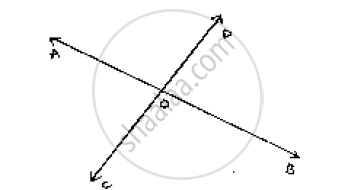
Given: `∠`AOC + `∠`COB + `∠`BOP = 270°
To find: `∠`AOC, `∠`COB, `∠`BOD and `∠`DOA
Here, `∠`AOC + `∠`COB + `∠`BOD + `∠`AOD = 360° [Complete angle]
⇒ 270 + `∠`AOD = 360°
⇒ `∠` AOD = 360° - 270°
⇒ `∠`AOD = 90°
Now,
`∠`AOD + `∠`BOD = 180° [Linear pair]
90 + `∠`BOD = 180°
⇒ `∠`BOD = 180° - 90°
∴ `∠`BOD = 90°
`∠`AOD = `∠`BOC = 90° [Vertically opposite angles]
`∠`BOD = `∠`AOC = 90° [Vertically opposite angles]
APPEARS IN
RELATED QUESTIONS
Consider the following statements:
When two straight lines intersect:
(i) adjacent angles are complementary
(ii) adjacent angles are supplementary
(iii) opposite angles are equal
(iv) opposite angles are supplementary
Of these statements
In the given figure, the value of y is
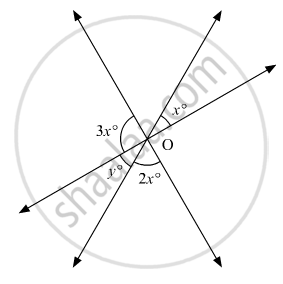
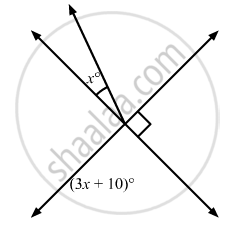
In the given figure, the value of x is ______.
Give two examples of parallel lines you can see in your environment.
Give two examples of perpendicular lines you can see in your environment.
Look at the picture given below. Decide whether the lines given in picture is parallel or perpendicular to each other and write the answer in the box.

Two lines are respectively perpendicular to two parallel lines. Show that they are parallel to each other.
Two parallel lines meet each other at some point.
Two lines in a plane which do not meet at a point anywhere are called ______ lines.
In the example of a 'Zebra crossing,' what feature specifically exemplifies the constant distance property of parallel lines?
