Advertisements
Advertisements
Question
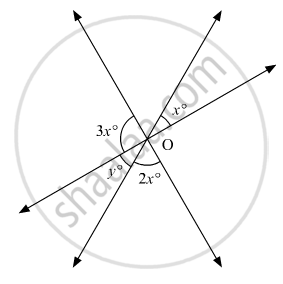
In the given figure, the value of y is
Options
20°
30°
45°
60°
Advertisements
Solution
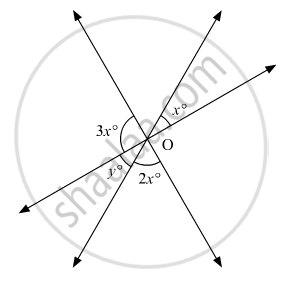
In the given figure, x°and y°are vertically opposite angles, therefore, these must be equal.
That is,
x =y ...(i)
Also, 2x°, y°and 3x° form a linear pair. Therefore, their sum must be supplementary.
That is,
2x + y + 3x = 180°
From (i) equation, we get:
2x + x +3x = 180°
6x = 180°
`x = (180°) /6`
x = 30°
From (i) equation again,
y =30°
APPEARS IN
RELATED QUESTIONS
How many pairs of adjacent angles are formed when two lines intersect in a point?
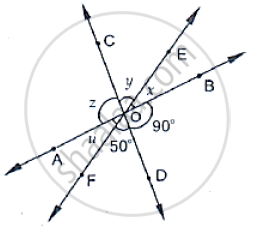
In the below fig, three coplanar lines intersect at a point O, forming angles as shown in the figure. Find the values of x, y, z and u.
Prove that the bisectors of a pair of vertically opposite angles are in the same straight line.
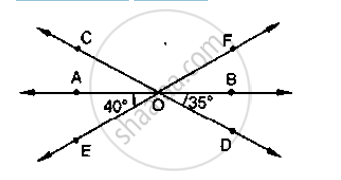
In the below fig, lines AB, CD and EF intersect at O. Find the measures of ∠AOC, ∠COF,
∠DOE and ∠BOF.
Two lines AB and CD intersect at O. If `∠`AOC + `∠`COB + `∠`BOD = 270°, find the
measures of `∠`AOC, `∠`COB, `∠`BOD and `∠`DOA.
Give two examples of parallel lines you can see in your environment.
Look at the picture given below. Decide whether the lines given in picture is parallel or perpendicular to each other and write the answer in the box.

Look at the picture given below. Decide whether the lines given in picture is parallel or perpendicular to each other and write the answer in the box.

Mention two real life situations where we use parallel lines
Two parallel lines meet each other at some point.
