Advertisements
Advertisements
Question
Two lines AB and CD intersect at O. If ∠AOC + ∠COB + ∠BOD = 270°, then ∠AOC =
Options
70°
80°
90°
180°
Advertisements
Solution
Let us draw the following diagram showing two lines AB and CD intersecting at a point O.
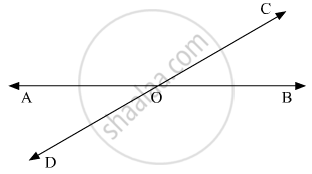
Thus, ∠AOC, ∠COB, ∠AODand ∠BODform a complete angle, that is the sum of these four angle is 360°.
That is,
∠AOC + ∠COB +∠BOD+ ∠AOD = 360° (I)
It is given that
∠AOC + ∠COB + ∠BOD = 270° (II)
Subtracting (II) from (I), we get:
∠AOD = 360° - 270°
∠AOD = 90°
If one of the four angles formed by two intersecting lines is a right angle, then each of the four angles will be a right angle.
So, ∠AOC = \[90^\circ\]
APPEARS IN
RELATED QUESTIONS
Prove that the bisectors of a pair of vertically opposite angles are in the same straight line.
If one of the four angles formed by two intersecting lines is a right angle, then show that
each of the four angles is a right angle.
Two lines AB and CD intersect at O. If `∠`AOC + `∠`COB + `∠`BOD = 270°, find the
measures of `∠`AOC, `∠`COB, `∠`BOD and `∠`DOA.
Consider the following statements:
When two straight lines intersect:
(i) adjacent angles are complementary
(ii) adjacent angles are supplementary
(iii) opposite angles are equal
(iv) opposite angles are supplementary
Of these statements
Given ∠POR = 3x and ∠QOR = 2x + 10°. If POQ is a straight line, then the value of x is
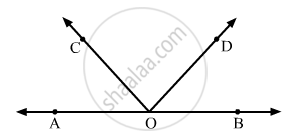
In the given figure, AOB is a straight line. If ∠AOC + ∠BOD = 85°, then ∠COD =
Give two examples of perpendicular lines you can see in your environment.
Look at the picture given below. Decide whether the lines given in picture is parallel or perpendicular to each other and write the answer in the box.

Two lines are respectively perpendicular to two parallel lines. Show that they are parallel to each other.
Which phrase correctly describes the distance between two parallel lines?
