Advertisements
Advertisements
प्रश्न
Two lines AB and CD intersect at O. If ∠AOC + ∠COB + ∠BOD = 270°, then ∠AOC =
विकल्प
70°
80°
90°
180°
Advertisements
उत्तर
Let us draw the following diagram showing two lines AB and CD intersecting at a point O.
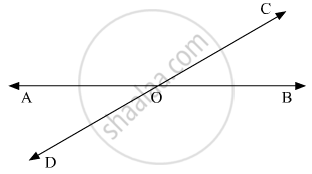
Thus, ∠AOC, ∠COB, ∠AODand ∠BODform a complete angle, that is the sum of these four angle is 360°.
That is,
∠AOC + ∠COB +∠BOD+ ∠AOD = 360° (I)
It is given that
∠AOC + ∠COB + ∠BOD = 270° (II)
Subtracting (II) from (I), we get:
∠AOD = 360° - 270°
∠AOD = 90°
If one of the four angles formed by two intersecting lines is a right angle, then each of the four angles will be a right angle.
So, ∠AOC = \[90^\circ\]
APPEARS IN
संबंधित प्रश्न
In the below fig, three coplanar lines intersect at a point O, forming angles as shown in the figure. Find the values of x, y, z and u.
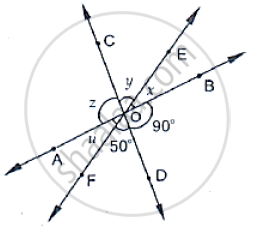
In the below fig, rays AB and CD intersect at O
Determine x when y =40
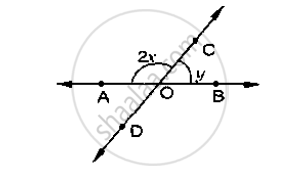
Given ∠POR = 3x and ∠QOR = 2x + 10°. If POQ is a straight line, then the value of x is
In the given figure, AOB is a straight line. If ∠AOC + ∠BOD = 85°, then ∠COD =
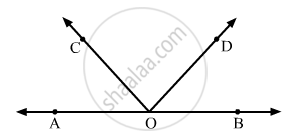
Mention two real life situations where we use parallel lines
Two lines are respectively perpendicular to two parallel lines. Show that they are parallel to each other.
Two lines in a plane which do not meet at a point anywhere are called ______ lines.
What is the geometric relationship between two straight lines in the same plane that will never intersect, no matter how much they are extended?
Which symbolic notation correctly represents the statement 'Line m is parallel to Line n?'
In the example of a 'Zebra crossing,' what feature specifically exemplifies the constant distance property of parallel lines?
