Advertisements
Advertisements
Question
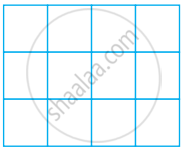
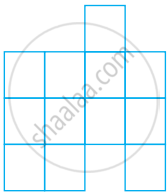
In the following figure, area of (i) is the same as the area of (ii).
 |
 |
| (i) | (ii) |
Options
True
False
Advertisements
Solution
This statement is True.
Explanation:
|
|
| (i) | (ii) |
By observing the figure, we can say that area of both figures are same because number of blocks used in both figures are same.
APPEARS IN
RELATED QUESTIONS
A path of uniform width, 3 m, runs around the outside of a square field of side 21 m. Find the area of the path.
Find the perimeter of the following figure
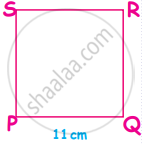

Measure the side of the red square on the dotted sheet. Draw here as many rectangles as possible using 12 such squares.
How many rectangles could you make?
Tahir measured the distance around a square field as 200 rods (lathi). Later he found that the length of this rod was 140 cm. Find the side of this field in metres.
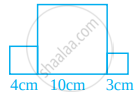
Three squares are joined together as shown in the following figure. Their sides are 4 cm, 10 cm and 3 cm. Find the perimeter of the figure.
Bajinder runs ten times around a square track and covers 4 km. Find the length of the track.
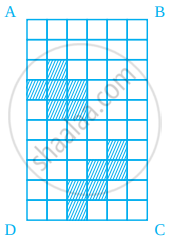
In the following figure, each square is of unit length
- What is the perimeter of the rectangle ABCD?
- What is the area of the rectangle ABCD?
- Divide this rectangle into ten parts of equal area by shading squares. (Two parts of equal area are shown here)
- Find the perimeter of each part which you have divided. Are they all equal?
A piece of string is 30 cm long. What will be the length of each side if the string is used to form a square?
If each side of a rhombus is doubled, how much will its area increase?
In the following figure, if (ii) is divided into squares of unit length, then its area is 13 unit squares.
|
| (ii) |
