Advertisements
Advertisements
Question
The length of a hall is 18 m and its width is 13.5 m. Find the least number of square tiles, each of side 25 cm, required to cover the floor of the hall,
(i) without leaving any margin.
(ii) leaving a margin of width 1.5 m all around. In each case, find the cost of the tiles required at the rate of Rs. 6 per tile
Advertisements
Solution
(i)
Length of hall (l) = 18 m and breadth (b) = 13.5 m
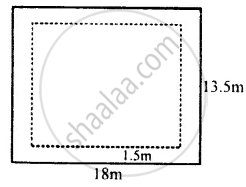
∴ Area of the floor = l × b
=`18 xx 13.5 "m"^2 = 243.0 "m"^2`
Side of each square tiles (a) = 25 cm
= `25/100 = 1/4`m
∴ Area of one tile = a2 = `1/4 xx 1/4`
= `1/16 "m"^2`
No. of tiles required = `243 + 1/16`
= `(243 xx 16)/1 = 3888`
Rate of tiles = Rs. 6 per tile
∴ Total cost = Rs. 3888 × 6
= Rs. 23328
(ii)
Width of margin left in side = 1.5 m
∴ Inner length = `18 - 2 xx 1.5 = 18 - 3 = 15` m
and breath = `13.5 - 2 xx 1.5 = 13.5 - 3`
= 10.5 m
∴ Inner area = `15 xx 10.5 "m"^2`
= 157.5 m2
∴ No. of tiles = 157.5 + `1/16`
= `157.5 xx 16 = 2520`
∴ Cost of tiles = 2520 × 6 = Rs. 15120
APPEARS IN
RELATED QUESTIONS
Find the perimeter of a square; whose area is: 1.69 m2
The diagonal of a square is 12 cm long; find its area and length of one side.
Your garden is in the shape of a square of side 5 m. Each side is to be fenced with 2 rows of wire. Find how much amount is needed to fence the garden at ₹ 10 per metre
Sanju completes 10 rounds around a square park every day. If one side of the park is 110 m, then find the distance covered by Sanju in a day in terms of kilometers and meters
1 m = ______ cm.
Parmindar walks around a square park once and covers 800 m. What will be the area of this park?
The perimeter of a square garden is 48 m. A small flower bed covers 18 sq m area inside this garden. What is the area of the garden that is not covered by the flower bed? What fractional part of the garden is covered by flower bed? Find the ratio of the area covered by the flower bed and the remaining area.
If each side of a rhombus is doubled, how much will its area increase?
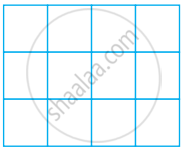
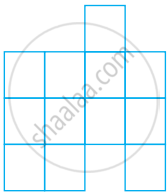
In the following figure, area of (i) is the same as the area of (ii).
 |
 |
| (i) | (ii) |
Two figures can have the same area but different perimeters.
