Advertisements
Advertisements
Question
If each side of a rhombus is doubled, how much will its area increase?
Options
1.5 times
2 times
3 times
4 times
Advertisements
Solution
3 times
Explanation:
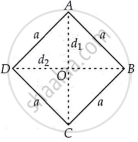
Let the given rhombus be ABCD with side length a unit and length of diagonals AC and BD are d1 and d2 respectively.
In ΔAOD,
(AD)2 = (OA)2 + (OD)2 ...[Using pythagoras theorem]
`a^2 = (d_1/2)^2 + (d_2/2)^2`
`\implies a = sqrt(d_1^2/4 + d_2^2/4)`
`\implies a = 1/2 sqrt(d_1^2 + d_2^2)`
`\implies 2a = sqrt(d_1^2 + d_2^2)` ...(1)
Now, side length of rhombus is doubled.
i.e., 2a and let length of new diagonals are d’1 and d’2·
`\implies 2a = sqrt((d_1^’/2)^2 + (d_2^’/2)^2`
Using (1), we get
`d_1^’ = 2d_1` and `d_2^’ = 2d_2`
Area of rhombus ABCD = `1/2 xx d_1 xx d_2 = 1/2d_1d_2`
After doubling the side length, area of rhombus = `1/2 xx 2d_1 xx 2d_2 = 2d_1d_2`
∴ Increase in area = `2d_1d_2 - 1/2 d_1d_2`
= `3/2 d_1d_2`
= 3 × (Area of rhombus ABCD)
APPEARS IN
RELATED QUESTIONS
The diagonal of a square is 15 m; find the length of its one side and perimeter.
The length of a hall is 18 m and its width is 13.5 m. Find the least number of square tiles, each of side 25 cm, required to cover the floor of the hall,
(i) without leaving any margin.
(ii) leaving a margin of width 1.5 m all around. In each case, find the cost of the tiles required at the rate of Rs. 6 per tile
Your garden is in the shape of a square of side 5 m. Each side is to be fenced with 2 rows of wire. Find how much amount is needed to fence the garden at ₹ 10 per metre
Find the perimeter of the following figure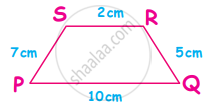
1 m = ______ cm.
Find the side of the square whose perimeter is 20 m.
In the following figure, if (ii) is divided into squares of unit length, then its area is 13 unit squares.
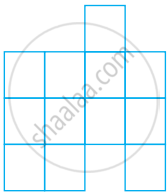 |
| (ii) |
Three squares are attached to each other as shown in the following figure. Each square is attached at the mid-point of the side of the square to its right. Find the perimeter of the complete figure.

The sum of the lengths of all sides of a square is also called its:
A square field has a side of 15 m. What is its perimeter?
