Advertisements
Advertisements
Question
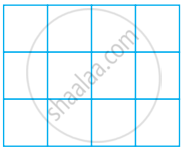
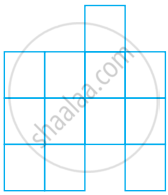
In the following figure, perimeter of (ii) is the same as (i).
 |
 |
| (i) | (ii) |
Options
True
False
Advertisements
Solution
This statement is False.
Explanation:
|
|
| (i) | (ii) |
By observing the figures, we can say that there are 2 new sides added in figure (i).
Therefore, the perimeter of (ii) is not same as (i).
APPEARS IN
RELATED QUESTIONS
The diagonal of a square is 12 cm long; find its area and length of one side.
The diagonal of a square is 15 m; find the length of its one side and perimeter.
A path of uniform width, 3 m, runs around the outside of a square field of side 21 m. Find the area of the path.
The table given below contains some measures of the square. Find the unknown values.
| Side | Perimeter | Area |
| ? | 100 m | ? |
Draw a square B whose side is twice of the square A. Calculate the perimeter of the squares A and B
1 sq cm = ______ cm × 1 cm.
1 sq m = ______ sq cm.
Bajinder runs ten times around a square track and covers 4 km. Find the length of the track.
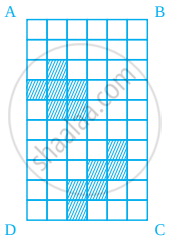
In the following figure, each square is of unit length
- What is the perimeter of the rectangle ABCD?
- What is the area of the rectangle ABCD?
- Divide this rectangle into ten parts of equal area by shading squares. (Two parts of equal area are shown here)
- Find the perimeter of each part which you have divided. Are they all equal?
What is the formula for the perimeter of a square with each side of length s units?
