Advertisements
Advertisements
Question
The perimeter of a square garden is 48 m. A small flower bed covers 18 sq m area inside this garden. What is the area of the garden that is not covered by the flower bed? What fractional part of the garden is covered by flower bed? Find the ratio of the area covered by the flower bed and the remaining area.
Advertisements
Solution
Let side of square garden be x cm.
Given that, perimeter of a square garden = 48 m
⇒ 4 × Side of a square = 48
⇒ 4x = 48
⇒ x = `48/4` = 12 m
Now, area of the square garden = (x)2 = (12)2 = 144 m2
Also, given, area of small flower bed cover inside the garden = 18 m2
∴ Area of the garden not covered by flower bed
= Area of square garden – Area of flower bed
= 144 – 18
= 126 m2
The fractional part of the garden covered by flower bed
= `"Area covered by flower bed"/"Total area of garden"`
= `18/144`
= `1/8`
Ratio of the area covered by the flower bed and remaining area
= `"Area covered by the flower"/"Area of remaining garden"`
= `18/126`
= `1/7`
Hence, the ratio of area covered by the flower bed and the remaining area is 1 : 7.
APPEARS IN
RELATED QUESTIONS
Find the perimeter of a square; whose area is: 1.69 m2
Find the perimeter and the area of the square whose side is 8 cm
The side of a square is 10 cm. If its side is tripled, then by how many times will its perimeter increase?
Your garden is in the shape of a square of side 5 m. Each side is to be fenced with 2 rows of wire. Find how much amount is needed to fence the garden at ₹ 10 per metre
Find the perimeter of the following figure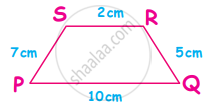
1 sq m = 1 m × ______ m = 100 cm × ______ cm.
In the following figure, area of (i) is the same as the area of (ii).
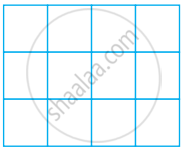 |
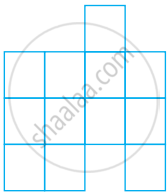 |
| (i) | (ii) |
In the following figure, perimeter of (ii) is 18 units.
|
| (ii) |
Three squares are attached to each other as shown in the following figure. Each square is attached at the mid-point of the side of the square to its right. Find the perimeter of the complete figure.

A square field has a side of 15 m. What is its perimeter?
