Advertisements
Advertisements
प्रश्न
The perimeter of a square garden is 48 m. A small flower bed covers 18 sq m area inside this garden. What is the area of the garden that is not covered by the flower bed? What fractional part of the garden is covered by flower bed? Find the ratio of the area covered by the flower bed and the remaining area.
Advertisements
उत्तर
Let side of square garden be x cm.
Given that, perimeter of a square garden = 48 m
⇒ 4 × Side of a square = 48
⇒ 4x = 48
⇒ x = `48/4` = 12 m
Now, area of the square garden = (x)2 = (12)2 = 144 m2
Also, given, area of small flower bed cover inside the garden = 18 m2
∴ Area of the garden not covered by flower bed
= Area of square garden – Area of flower bed
= 144 – 18
= 126 m2
The fractional part of the garden covered by flower bed
= `"Area covered by flower bed"/"Total area of garden"`
= `18/144`
= `1/8`
Ratio of the area covered by the flower bed and remaining area
= `"Area covered by the flower"/"Area of remaining garden"`
= `18/126`
= `1/7`
Hence, the ratio of area covered by the flower bed and the remaining area is 1 : 7.
APPEARS IN
संबंधित प्रश्न
The diagonal of a square is 15 m; find the length of its one side and perimeter.
The length of a hall is 18 m and its width is 13.5 m. Find the least number of square tiles, each of side 25 cm, required to cover the floor of the hall,
(i) without leaving any margin.
(ii) leaving a margin of width 1.5 m all around. In each case, find the cost of the tiles required at the rate of Rs. 6 per tile
The table given below contains some measures of the square. Find the unknown values.
| Side | Perimeter | Area |
| 6 cm | ? | ? |
The side of a square is 10 cm. If its side is tripled, then by how many times will its perimeter increase?
Tahir measured the distance around a square field as 200 rods (lathi). Later he found that the length of this rod was 140 cm. Find the side of this field in metres.
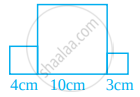
Three squares are joined together as shown in the following figure. Their sides are 4 cm, 10 cm and 3 cm. Find the perimeter of the figure.
If each side of a rhombus is doubled, how much will its area increase?
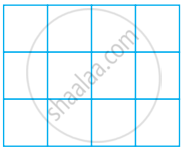
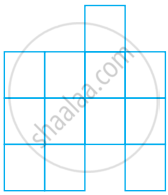
In the following figure, perimeter of (ii) is the same as (i).
 |
 |
| (i) | (ii) |
In the following figure, if (ii) is divided into squares of unit length, then its area is 13 unit squares.
|
| (ii) |
A square field has a side of 15 m. What is its perimeter?
