Advertisements
Advertisements
प्रश्न
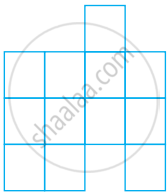
In the following figure, if (ii) is divided into squares of unit length, then its area is 13 unit squares.
 |
| (ii) |
पर्याय
True
False
Advertisements
उत्तर
This statement is False.
Explanation:
|
| (ii) |
We know that,
Area of square = Side × Side
Then area of 1 square = 1 × 1 = 1 unit squares
There are 12 squares in figure (ii)
Therefore, area of figure (ii) = 12 × 1 = 12 unit squares.
APPEARS IN
संबंधित प्रश्न
A path of uniform width, 3 m, runs around the outside of a square field of side 21 m. Find the area of the path.
The length of a hall is 18 m and its width is 13.5 m. Find the least number of square tiles, each of side 25 cm, required to cover the floor of the hall,
(i) without leaving any margin.
(ii) leaving a margin of width 1.5 m all around. In each case, find the cost of the tiles required at the rate of Rs. 6 per tile
A wire, when bent in the form of a square encloses an area of 484 cm2. Find :
(i) one side of the square ;
(ii) length of the wire ;
(iii) the largest area enclosed; if the same wire is bent to form a circle.
Find the perimeter and the area of the square whose side is 8 cm
Find the perimeter of the following figure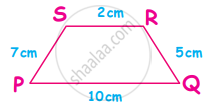
1 sq m = ______ sq cm.
If each side of a rhombus is doubled, how much will its area increase?
Three squares are attached to each other as shown in the following figure. Each square is attached at the mid-point of the side of the square to its right. Find the perimeter of the complete figure.

If the perimeter of a square is 36 cm, what is the length of one side?
A square field has a side of 15 m. What is its perimeter?
