Advertisements
Advertisements
प्रश्न
Sanju completes 10 rounds around a square park every day. If one side of the park is 110 m, then find the distance covered by Sanju in a day in terms of kilometers and meters
Advertisements
उत्तर
Perimeter = 4 × 110 m
= 440 m
10 rounds = 440 × 10
= 4400 m
= `4400/1000`
= 4.4 km
APPEARS IN
संबंधित प्रश्न
The diagonal of a square is 15 m; find the length of its one side and perimeter.
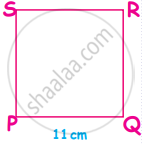
Your garden is in the shape of a square of side 5 m. Each side is to be fenced with 2 rows of wire. Find how much amount is needed to fence the garden at ₹ 10 per metre
Find the perimeter of the following figure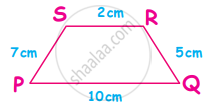
Find the perimeter of the following figure
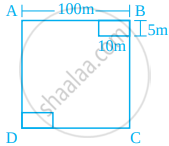
A square shaped park ABCD of side 100 m has two equal rectangular flower beds each of size 10 m × 5 m (Figure). Length of the boundary of the remaining park is ______.
1 sq m = ______ sq cm.
Find the side of the square whose perimeter is 20 m.
Sweety runs around a square park of side 75 m. Bulbul runs around a rectangular garden with a length of 60 m and a breadth of 45 m. Who covers less distance?
In the following figure, area of (i) is the same as the area of (ii).
 |
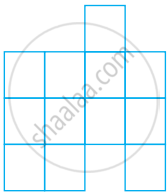 |
| (i) | (ii) |
In the following figure, perimeter of (ii) is the same as (i).
|
|
| (i) | (ii) |
