Advertisements
Advertisements
प्रश्न
The perimeter of a square garden is 48 m. A small flower bed covers 18 sq m area inside this garden. What is the area of the garden that is not covered by the flower bed? What fractional part of the garden is covered by flower bed? Find the ratio of the area covered by the flower bed and the remaining area.
Advertisements
उत्तर
Let side of square garden be x cm.
Given that, perimeter of a square garden = 48 m
⇒ 4 × Side of a square = 48
⇒ 4x = 48
⇒ x = `48/4` = 12 m
Now, area of the square garden = (x)2 = (12)2 = 144 m2
Also, given, area of small flower bed cover inside the garden = 18 m2
∴ Area of the garden not covered by flower bed
= Area of square garden – Area of flower bed
= 144 – 18
= 126 m2
The fractional part of the garden covered by flower bed
= `"Area covered by flower bed"/"Total area of garden"`
= `18/144`
= `1/8`
Ratio of the area covered by the flower bed and remaining area
= `"Area covered by the flower"/"Area of remaining garden"`
= `18/126`
= `1/7`
Hence, the ratio of area covered by the flower bed and the remaining area is 1 : 7.
APPEARS IN
संबंधित प्रश्न
The perimeter of a square is numerically equal to its area. Find its area.
A path of uniform width, 3 m, runs around the outside of a square field of side 21 m. Find the area of the path.
A wire, when bent in the form of a square encloses an area of 484 cm2. Find :
(i) one side of the square ;
(ii) length of the wire ;
(iii) the largest area enclosed; if the same wire is bent to form a circle.
The table given below contains some measures of the square. Find the unknown values.
| Side | Perimeter | Area |
| ? | 100 m | ? |
Your garden is in the shape of a square of side 5 m. Each side is to be fenced with 2 rows of wire. Find how much amount is needed to fence the garden at ₹ 10 per metre
A square shaped park ABCD of side 100 m has two equal rectangular flower beds each of size 10 m × 5 m (Figure). Length of the boundary of the remaining park is ______.
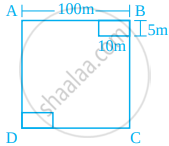
Find the cost of fencing a square park of side 250 m at the rate of ₹ 20 per metre.
Avneet buys 9 square paving slabs, each with a side of `1/2` m. He lays them in the form of a square.
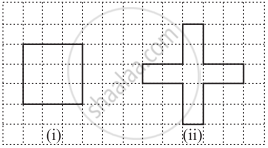
- What is the perimeter of his arrangement [Fig (i)]?
- Shari does not like his arrangement. She gets him to lay them out like a cross. What is the perimeter of her arrangement [(Fig (ii)]?
- Which has greater perimeter?
- Avneet wonders if there is a way of getting an even greater perimeter. Can you find a way of doing this? (The paving slabs must meet along complete edges i.e. they cannot be broken.)
Three squares are attached to each other as shown in the following figure. Each square is attached at the mid-point of the side of the square to its right. Find the perimeter of the complete figure.

If the perimeter of a square is 36 cm, what is the length of one side?
