Advertisements
Advertisements
प्रश्न
A magazine charges Rs 300 per 10 sq cm area for advertising. A company decided to order a half page advertisment. If each page of the magazine is 15 cm × 24 cm, what amount will the company has to pay for it?
Advertisements
उत्तर
Given, charges for 10 sq cm advertisement = ₹ 300
∴ Charges for 1 sq cm advertisement = `(₹ 300)/(10 "sq cm") xx 1` sq cm = ₹ 30
In order to find out the amount the company has to pay for a half page advertisement, we will find the area of half page of magazine and then multiply it with the charges for 1 sq cm advertisement.
Now, area of 1 page of magazine
= 15 cm × 24 cm
= 360 cm2
∴ Area of a half page of magazine
= `("Area of" 1 "page of magazine")/2`
= `360/2`
= 180 cm2
So, charges for half page advertisement
= Area of half page of magazine × Charges for 1 sq cm advertisement
= 180 × 30
= ₹ 5400
Hence, the company has to pay ₹ 5400 for it.
APPEARS IN
संबंधित प्रश्न
If ABCD is a parallelogram, then prove that
𝑎𝑟 (Δ𝐴𝐵𝐷) = 𝑎𝑟 (Δ𝐵𝐶𝐷) = 𝑎𝑟 (Δ𝐴𝐵𝐶) = 𝑎𝑟 (Δ𝐴𝐶𝐷) = `1/2` 𝑎𝑟 (||𝑔𝑚 𝐴𝐵𝐶𝐷) .
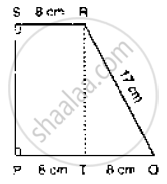
Compute the area of trapezium PQRS is Fig. below.
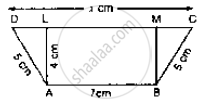
In the below fig. ABCD is a trapezium in which AB = 7 cm, AD = BC = 5 cm, DC = x cm,
and distance between AB and DC is 4cm. Find the value of x and area of trapezium ABCD.
If P is any point in the interior of a parallelogram ABCD, then prove that area of the
triangle APB is less than half the area of parallelogram.
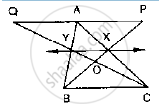
In the below fig. X and Y are the mid-points of AC and AB respectively, QP || BC and
CYQ and BXP are straight lines. Prove that ar (Δ ABP) = ar (ΔACQ).
The figure obtained by joining the mid-points of the adjacent sides of a rectangle of sides 8 cm and 6 cm is ______.
Find the area of a rectangle whose length and breadth are 25 m and 16 cm.
The table given below contains some measures of the rectangle. Find the unknown values.
| Length | Breadth | Perimeter | Area |
| 13 cm | ? | 54 cm | ? |
An engineer who plans to build a compound wall on all sides of a house must find the area of the compound.
If a figure contains only 8 fully-filled squares and no partial squares, what is its area?
