Advertisements
Advertisements
Question
In the following fig. shows a radioactive source S in a thick lead container. The radiations pass through an electric field between the plates P and Q. Complete the diagram to show the paths of α , β and γ radiations.
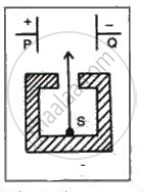
Why is the source S placed in a thick lead container?
Advertisements
Solution
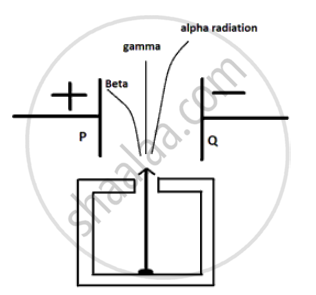
(i) Alpha particles are heavy in mass and are positively charged so they are deflected less and are deflected towards - charged plate.
(ii) Beta particles are negIigible in mass so they are highly deflected by electric field anc they are negatively charge particle so they are deflected towards positive charged plate.
(iii) Gamm a radiations have no mass and no charge so they are not deflected by electric field.
Source S is placed in thick lead container because it is radioactive substance and radiates. Thick walls of lead absorb a II the radiation except radiation going straight outside towards opened end. Thus, thick walIs help to reduce leakage of radiations outside.
APPEARS IN
RELATED QUESTIONS
What are the uses of radioactive isotopes in following?
(a) Medical field,
(b) Agriculture,
(c) Industries?
Define bound electrons.
What are ‘Becquerel rays’?
What is meant by Radioactivity?
Justify with reason, whether the following nuclear reactions are allowed or not.
\[\ce{^A_Z X -> ^A_{Z + 1}Y + ^0_{-1}β}\]
Unit of radioactivity is _______
Which of the following statements is/are correct?
- α particles are photons
- Penetrating power of γ radiation is very low
- Ionization power is maximum for α rays
- Penetrating power of γ radiation is very high
Two radioactive sources A and B of half lives of 1 hour and 2 hours, respectively, initially contain the same number of radioactive atoms. At the end of two hours, their rates of disintegration are in the ratio of ______.
Which of the following correctly lists the three major types of radioactive decay found in nature?
