Advertisements
Advertisements
प्रश्न
In the following fig. shows a radioactive source S in a thick lead container. The radiations pass through an electric field between the plates P and Q. Complete the diagram to show the paths of α , β and γ radiations.
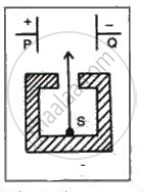
Why is the source S placed in a thick lead container?
Advertisements
उत्तर
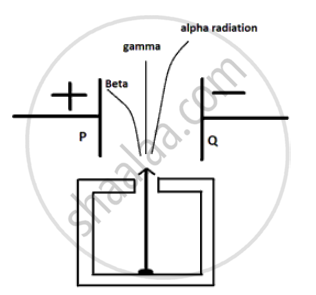
(i) Alpha particles are heavy in mass and are positively charged so they are deflected less and are deflected towards - charged plate.
(ii) Beta particles are negIigible in mass so they are highly deflected by electric field anc they are negatively charge particle so they are deflected towards positive charged plate.
(iii) Gamm a radiations have no mass and no charge so they are not deflected by electric field.
Source S is placed in thick lead container because it is radioactive substance and radiates. Thick walls of lead absorb a II the radiation except radiation going straight outside towards opened end. Thus, thick walIs help to reduce leakage of radiations outside.
APPEARS IN
संबंधित प्रश्न
How can they be made to leave the metal surface? (State any two ways)
What happens to the mass number of an element when (i) an α -particle, (ii) a β -particle, and (iii) γ -radiation is emitted?
Define the term radioactivity.
From α, β and γ-rays, name the one which travels with the speed of light?
It is advised not to touch a radioactive substance by hand. Give reason.
A radioactive material decays by simultaneous emissions of two particles with half-lives of 1400 years and 700 years respectively. What will be the time after which one-third of the material remains? (Take In3 = 1.1)
Calculate the time interval between 33% decay and 67% decay if half-life of a substance is 20 minutes.
Why do the nuclei of some atoms undergo radioactive decay?
