Advertisements
Advertisements
Question
If copper is kept exposed to damp air for a considerable time, it gets a green coating on its surface. This is due to the formation of ______.
Options
hydrated copper sulphate
copper oxide
basic copper carbonate
copper nitrate
Advertisements
Solution
If copper is kept exposed to damp air for a considerable time, it gets a green coating on its surface. This is due to the formation of basic copper carbonate.
Explanation:
When copper is exposed to damp air for a long time, it slowly undergoes corrosion by reacting with atmospheric carbon dioxide, oxygen, and water vapour. This chemical reaction forms a green layer on its surface, which is a basic mixture of copper carbonate and copper hydroxide [CuCO3.Cu(OH)2]. The other options are incorrect because copper oxide is black or brown, while copper sulphate and copper nitrate typically form blue or blue-green crystals under different laboratory conditions, rather than a natural corrosion patina.
APPEARS IN
RELATED QUESTIONS
Write two methods of preventing the rusting of iron.
Give reasons:
Platinum, gold and silver are used to make jewellery.
Tiffin boxes are electroplated with ______ but car bumpers are electroplated with ______ to protect them from rusting.
Explain why, the galvanised iron article is protected against rusting even if the zinc layer is broken.
A common metal which is highly resistant to corrosion is ______.
A metal X which is resistant to corrosion is produced by the electrolysis of its molten oxide whereas another metal Y which is also resistant to corrosion is produced by the reduction of its oxide with carbon. Metal X can be used in powder form in thermite welding whereas metal Y is used in making cathodes of ordinary dry cells.
- Name the metals X and Y.
- Which of the two metals is more reactive: X or Y?
- Name one ore or metal X. Also write its chemical formula.
- Name one ore of metal Y. Also write its chemical formula.
- Name one alloy of metal X and one alloy of metal Y.
Four metals P, Q, R and S are all obtained by the reduction of their oxides with carbon. Metal P is used to form a thin layer over the sheets of metal S to prevent its corrosion. Metal Q is used for electroplating tiffin boxes made of metal S whereas metal R is used in making car batteries. Metals Q and R form an alloy called solder. What are metals P, Q, R and S? How have you arrived at this conclusion?
Mention two uses of the following metals and non-metals
Iron
Bronze is an alloy of ______.
Explain with reason:
Roasting is carried out on sulphide ores and not on carbonate ores.
Find the odd one out and give its explanation.
Find the odd one out and give its explanation.
Draw a neat labelled diagram.
Electrolysis
Observe the following diagram and write answers.
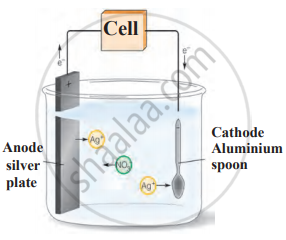
- Name the method.
- Explain the method.
- Give two examples of this method.
The diagram shows the reaction between metal and dil. acid.

What is the reason for different behaviour of Mg in test tube B?
Alloys are homogeneous mixtures of a metal with a metal or non-metal. Which among the following alloys contain non-metal as one of its constituents?
Generally, when metals are treated with mineral acids, hydrogen gas is liberated but when metals (except Mn and Mg), treated with HNO3, hydrogen is not liberated, why?
Give an example of a chemical reaction for the following situation:
Sound is produced
Gold plated ornaments is the example of ______.
