Advertisements
Advertisements
Question
A metal X which is resistant to corrosion is produced by the electrolysis of its molten oxide whereas another metal Y which is also resistant to corrosion is produced by the reduction of its oxide with carbon. Metal X can be used in powder form in thermite welding whereas metal Y is used in making cathodes of ordinary dry cells.
- Name the metals X and Y.
- Which of the two metals is more reactive: X or Y?
- Name one ore or metal X. Also write its chemical formula.
- Name one ore of metal Y. Also write its chemical formula.
- Name one alloy of metal X and one alloy of metal Y.
Advertisements
Solution
- Metal X is aluminium (Al) and metal Y is zinc (Zn). Aluminium is corrosion-resistant due to its protective oxide layer and is used in thermite welding. Zinc is also corrosion-resistant (used in galvanisation) and forms the anode (outer container) of ordinary dry cells.
- X (aluminium) is more reactive than Y (zinc). Aluminium is placed above zinc in the reactivity series.
- One ore of metal X (aluminium) is bauxite ore. The chemical formula of bauxite ore is Al2O3.2H2O.
- One ore of metal Y (zinc) is calamine ore. The chemical formula of calamine ore is ZnCO3.
- One alloy of metal X (aluminium) is magnalium, which consists of aluminium and magnesium. One alloy of metal Y (zinc) is brass, which consists of zinc and copper.
APPEARS IN
RELATED QUESTIONS
Which metals do not corrode easily?
What are alloys?
Explain the term “corrosion” with an example. Write a chemical equation to show the process of corrosion of iron.
In one method of rust prevention, the iron is not coated with anything. Which is this method?
Name five methods of preventing rusting of iron.
What are the special properties of stainless steel?
Name the metal which is a constituent of blood pigment?
Answer the following question:
What is corrosion? Do gold ornaments corrode? Justify.
_______ is an alloy made from iron, carbon and chromium.
_______ forms a green colour in the water.
Find the odd one out and give its explanation.
Write scientific reason.
Coins are made from metals and alloys.
What is rust?
Observe the following diagram and give answers.
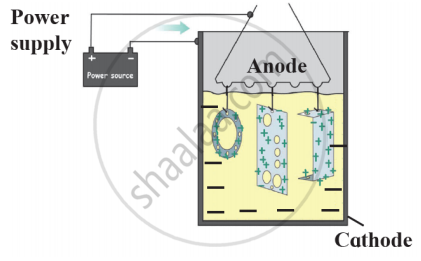
- Name this method of prevention of corrosion.
- For prevention of which metal this method is used?
- What is used as anode in this method?
Observe the following figure and write the answer of the question.
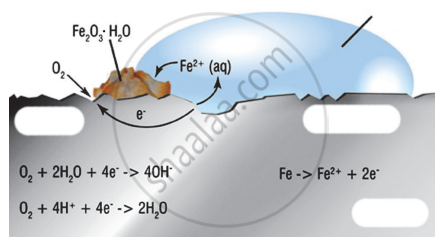
- Which process is shown in the figure?
- Explain the chemical reaction shown in the figure.
- Write the reactions on anode and cathode.
The process of coating the surface of the metal with a thin layer of zinc is called ______
Copper objects lose their shine and form green coating of ____________.
Identify the correct statement from the following:
Gold plated ornaments is the example of ______.
| A process of forming a thick oxide of aluminium when aluminium is exposed to air. This coat makes it resistant to corrosion. Resistance can be improved by making a layer of oxide thinker. In this technique, the aluminium article is the anode, and the electrolyte is sulphuric acid. The anode reaction results in the formation of a black-coloured film of aluminium oxide on the anode. By putting appropriate dyes in the electrolytic solution, both coloured surface with the decorative finish is achieved. Kitchen articles like anodised such as pressure cookers, pans and frames of sliding windows are applications of this technique. |
- Name the anode and electrolyte used in this technique.
- How can we make aluminium articles made resistant to corrosion?
- Name the technique used to coat the aluminium articles.
