If α and β are the zeros of the quadratic polynomial f(x) = ax^2 + bx + c, then evaluate beta/(aalpha + b) + alpha/(abeta + b).
Advertisements
Question
If α and β are the zeros of the quadratic polynomial f(x) = ax2 + bx + c, then evaluate `beta/(aalpha + b) + alpha/(abeta + b)`.
Advertisements
Solution
f(x) = ax2 + bx + c
α + β = `(-b/a)`
αβ = `c/a`
Since α + β are the roots (or) zeroes of the given polynomials
Then
`beta/(aalpha+b)+alpha/(abeta+b)`
`=(beta(abeta+b)+alpha(aalpha+b))/((aalpha+b)(abeta+b))`
`=(abeta^2+b beta+aalpha^2+balpha)/(a^2alphabeta+abalpha+ab beta+b^2)`
`=(aalpha^2+abeta^2+b beta+balpha)/(a^2xxc/a+ab(alpha+beta)+b^2)`
`=(a(alpha^2+beta^2)+b(alpha+beta))/(ac+ab(-b/a)+b^2)`
`=(a[(alpha+beta)^2-2alphabeta]+bxx-b/a)/(ac-b^2+b^2)`
`=(a[(-b/a)^2-2(c/a)]-b^2/a)/(ac)`
`=((b^2)/a-(2c)-b^2/a)/(ac)`
`=(-2c)/(ac)`
`=(-2)/a`
APPEARS IN
RELATED QUESTIONS
Find a quadratic polynomial with the given numbers as the sum and product of its zeroes respectively.
`-1/4 ,1/4`
If the sum of the zeros of the quadratic polynomial f(t) = kt2 + 2t + 3k is equal to their product, find the value of k.
Find the zeroes of the quadratic polynomial 2x2 – 11x + 15 and verify the relation between the zeroes and the coefficients.
Find the quadratic polynomial, sum of whose zeroes is 0 and their product is -1. Hence, find the zeroes of the polynomial.
Find the quotient and the remainder when f(x) = x4 – 5x + 6 is divided by g(x) = 2 – x2.
On dividing 3x3 + x2 + 2x + 5 is divided by a polynomial g(x), the quotient and remainder are (3x – 5) and (9x + 10) respectively. Find g(x).
If 2 and -2 are two zeroes of the polynomial `(x^4 + x^3 – 34x^2 – 4x + 120)`, find all the zeroes of the given polynomial.
If α, β are the zeroes of the polynomial f(x) = 5x2 – 7x + 1 then `1/α + 1/β = ?`
Basketball and soccer are played with a spherical ball. Even though an athlete dribbles the ball in both sports, a basketball player uses his hands and a soccer player uses his feet. Usually, soccer is played outdoors on a large field and basketball is played indoor on a court made out of wood. The projectile (path traced) of soccer ball and basketball are in the form of parabola representing quadratic polynomial.

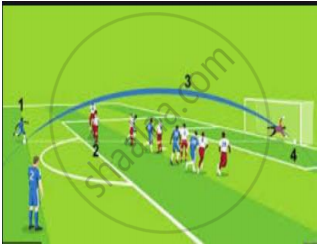
What will be the expression of the polynomial?
Find the zeroes of the following polynomials by factorisation method and verify the relations between the zeroes and the coefficients of the polynomials:
5t2 + 12t + 7
The zeroes of the quadratic polynomial x2 + 99x + 127 are ______.
Find the zeroes of the following polynomials by factorisation method and verify the relations between the zeroes and the coefficients of the polynomials:
`v^2 + 4sqrt(3)v - 15`
If one zero of the polynomial p(x) = 6x2 + 37x – (k – 2) is reciprocal of the other, then find the value of k.
Find the zeroes of the quadratic polynomial x2 + 6x + 8 and verify the relationship between the zeroes and the coefficients.
If α, β are zeroes of quadratic polynomial 5x2 + 5x + 1, find the value of α–1 + β–1.
For the quadratic equation \[ ax^{2} + bx + c = 0 \] with roots \[ \alpha, \beta \], the sum of the roots \( \alpha + \beta \) equals:
In the relation between zeroes (roots) and coefficients of \[ ax^{2} + bx + c = 0 \], what is the status of the pairwise product of the roots?
For the cubic equation \[ ax^{3} + bx^{2} + cx + d = 0 \] with roots \[ \alpha, \beta, \gamma \], the product of the roots \( \alpha\beta\gamma \) equals:
