Advertisements
Advertisements
Question
If 2 and -2 are two zeroes of the polynomial `(x^4 + x^3 – 34x^2 – 4x + 120)`, find all the zeroes of the given polynomial.
Advertisements
Solution
Let f(x) = x^4 + x^3 – 34x^2 – 4x + 120
Since 2 and -2 are the zeroes of f(x), it follows that each one of (x – 2) and (x + 2) is a factor of f(x).
Consequently, (x – 2) (x + 2) = (x2 – 4) is a factor of f(x).
On dividing f(x) by `(x^2 – 4)`, we get:
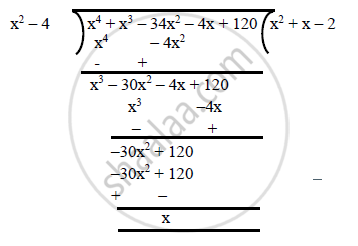
f(x) = 0
⇒` (x2 + x – 30) (x^2 – 4) = 0`
⇒` (x^2 + 6x – 5x – 30) (x – 2) (x + 2)`
⇒ `[x(x + 6) – 5(x + 6)] (x – 2) (x + 2)`
⇒`(x – 5) (x + 6) (x – 2) (x + 2) = 0`
⇒` x = 5 or x = -6 or x = 2 or x = -2`
Hence, all the zeroes are 2, -2, 5 and -6.
RELATED QUESTIONS
Find the zeroes of the following quadratic polynomial and verify the relationship between the zeroes and the coefficients.
6x2 – 3 – 7x
Find a quadratic polynomial with the given numbers as the sum and product of its zeroes respectively.
1, 1
Find a cubic polynomial with the sum, sum of the product of its zeroes taken two at a time, and the product of its zeroes as 2, − 7, − 14 respectively
Find the zeroes of the following quadratic polynomials and verify the relationship between the zeroes and the coefficients.
`p(x) = x^2 + 2sqrt2x + 6`
If α and β are the zeros of the quadratic polynomial f(t) = t2 − 4t + 3, find the value of α4β3 + α3β4.
If the zeros of the polynomial f(x) = ax3 + 3bx2 + 3cx + d are in A.P., prove that 2b3 – 3abc + a2d = 0.
Find the quadratic polynomial whose zeroes are `2/3` and `(-1)/4`. Verify the relation between the coefficients and the zeroes of the polynomial.
Find a cubic polynomial whose zeroes are 2, –3 and 4.
Find the quotient and the remainder when f(x) = x4 – 3x2 + 4x + 5 is divided by g(x) = x2 – x + 1.
If α, β are the zeroes of the polynomial f(x) = x2 + x – 2, then `(α/β - α/β)`.
Define a polynomial with real coefficients.
What should be subtracted to the polynomial x2 − 16x + 30, so that 15 is the zero of the resulting polynomial?
If 2 and `1/2` are the zeros of px2 + 5x + r, then ______.
A quadratic polynomial, whose zeroes are –3 and 4, is ______.
Find the zeroes of the following polynomials by factorisation method and verify the relations between the zeroes and the coefficients of the polynomials:
4x2 – 3x – 1
For the following, find a quadratic polynomial whose sum and product respectively of the zeroes are as given. Also find the zeroes of these polynomials by factorisation.
`-2sqrt(3), -9`
Given that `sqrt(2)` is a zero of the cubic polynomial `6x^3 + sqrt(2)x^2 - 10x - 4sqrt(2)`, find its other two zeroes.
Find the zeroes of the following polynomials by factorisation method and verify the relations between the zeroes and the coefficients of the polynomials:
`v^2 + 4sqrt(3)v - 15`
If one zero of the polynomial p(x) = 6x2 + 37x – (k – 2) is reciprocal of the other, then find the value of k.
A quadratic polynomial the sum and product of whose zeroes are – 3 and 2 respectively, is ______.
