Advertisements
Advertisements
Question
If a = 0.72 and r = 0.24, then the value of tr is ______.
Options
0.02
0.04
0.4
0.2
Advertisements
Solution
If a = 0.72 and r = 0.24, then the value of tr is 0.04.
Explanation:
Express the relation of absorptivity. The fraction of light/ray/radiation absorbed by a surface is called absorptivity.
`a = (G_(abs))/G`
`G_(abs) =Ga`
Here, `G_(abs)` is absorbed radiation and G is incident radiation.
Express the relation of reflectivity.
The fraction of light reflected by a surface is known as reflectivity.
`r = (G_(ref))/G`
`G_(ref) = Gr`
Here, `G_(ref)` is reflected radiation.
Express the relation of transmissivity. The fraction of light/ray/radiation transmitted by a surface is known as transmissivity.
`t_r = G_t/G`
`G_t = Gt_r`
Here, `G_t` is transmitted radiation.
Express the relation of 1st law of thermodynamics. Sum of all radiation (absorbed, reflected and transmitted) should be equals to the total radiation.
`G_(abs) + G_(ref) + G_t = G` ......(i)
Substitute `Ga` for `G_(abs), G_r` for `G_(mf)` and Gt for Gt in equation (i).
`(Ga)/G + (Gr)/G + (Gt_r)/G` = 1
`a + r + t_r` = 1
Substitute 0.72 for a and 0.24 for r to find transmitted radiation.
0.72 + 0.24 + tr = 1
tr = 1 – 0.96
tr = 0.04
APPEARS IN
RELATED QUESTIONS
When we place a gas cylinder on a van and the van moves, does the kinetic energy of the molecules increase? Does the temperature increase?
The pressure of an ideal gas is written as \[P = \frac{2E}{3V}\] . Here E refers to
The mean square speed of the molecules of a gas at absolute temperature T is proportional to
Find the number of molecules of an ideal gas in a volume of 1.000 cm3 at STP.
At what temperature the mean speed of the molecules of hydrogen gas equals the escape speed from the earth?
Use R = 8.314 JK-1 mol-1
Air is pumped into the tubes of a cycle rickshaw at a pressure of 2 atm. The volume of each tube at this pressure is 0.002 m3. One of the tubes gets punctured and the volume of the tube reduces to 0.0005 m3. How many moles of air have leaked out? Assume that the temperature remains constant at 300 K and that the air behaves as an ideal gas.
Use R = 8.3 J K-1 mol-1
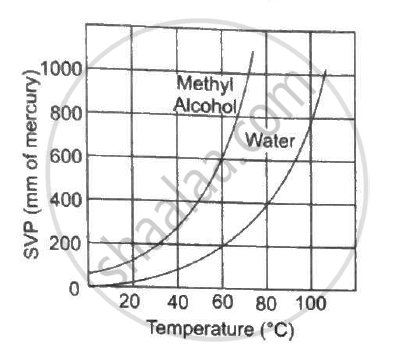
Using figure, find the boiling point of methyl alcohol at 1 atm (760 mm of mercury) and at 0.5 atm.
An adiabatic cylindrical tube of cross-sectional area 1 cm2 is closed at one end and fitted with a piston at the other end. The tube contains 0.03 g of an ideal gas. At 1 atm pressure and at the temperature of the surrounding, the length of the gas column is 40 cm. The piston is suddenly pulled out to double the length of the column. The pressure of the gas falls to 0.355 atm. Find the speed of sound in the gas at atmospheric temperature.
Answer in brief:
A gas in a cylinder is at pressure P. If the masses of all the molecules are made one-third of their original value and their speeds are doubled, then find the resultant pressure.
If the density of oxygen is 1.44 kg/m3 at a pressure of 105 N/m2, find the root mean square velocity of oxygen molecules.
Calculate the ratio of the mean square speeds of molecules of a gas at 30 K and 120 K.
Two vessels A and B are filled with the same gas where the volume, temperature, and pressure in vessel A is twice the volume, temperature, and pressure in vessel B. Calculate the ratio of the number of molecules of the gas in vessel A to that in vessel B.
The power radiated by a perfect blackbody depends only on its ______
Calculate the value of λmax for radiation from a body having a surface temperature of 3000 K. (b = 2.897 x 10⁻³ m K)
Calculate the energy radiated in one minute by a blackbody of surface area 200 cm2 at 127 °C (σ = 5.7 x 10⁻⁸ J m-2 s-1 K-4)
Under which condition laws of Boyle, Charles, and Gay-Lussac are valid?
Explain in detail the kinetic interpretation of temperature.
The average translational kinetic energy of a molecule in a gas becomes equal to 0.49 eV at a temperature about (Boltzmann constant = 1.38 x 10⁻²³ JK-1) ____________.
Two molecules of a gas have speeds of 9 × 10 6 ms−1 and 1 × 10⁶ ms−1, respectively. What is the root mean square speed of these molecules?
A gas mixture consists of molecules of types A, B and C with masses mA > mB > mC. Rank the three types of molecules in decreasing order of rms speeds.
An insulated container containing monoatomic gas of molar mass m is moving with a velocity vo. If the container is suddenly stopped, find the change in temperature.
Explain why there is no atmosphere on moon.
23Ne decays to 23Na by negative beta emission. Mass of 23Ne is 22.994465 amu mass of 23Na is 22.989768 amu. The maximum kinetic energy of emitted electrons neglecting the kinetic energy of recoiling product nucleus is ______ MeV.
A proton, a deuteron and an α-particle with same kinetic energy enter into a uniform magnetic field at right angle to magnetic field. The ratio of the radii of their respective circular paths is ______.
If a = 0. 72 and t = 0.04, then the value of r is ______.
Which of the following materials is diathermanous?
Show that the average energy per molecule is directly proportional to the absolute temperature ‘T’ of the gas.
