Advertisements
Advertisements
प्रश्न
If a = 0.72 and r = 0.24, then the value of tr is ______.
विकल्प
0.02
0.04
0.4
0.2
Advertisements
उत्तर
If a = 0.72 and r = 0.24, then the value of tr is 0.04.
Explanation:
Express the relation of absorptivity. The fraction of light/ray/radiation absorbed by a surface is called absorptivity.
`a = (G_(abs))/G`
`G_(abs) =Ga`
Here, `G_(abs)` is absorbed radiation and G is incident radiation.
Express the relation of reflectivity.
The fraction of light reflected by a surface is known as reflectivity.
`r = (G_(ref))/G`
`G_(ref) = Gr`
Here, `G_(ref)` is reflected radiation.
Express the relation of transmissivity. The fraction of light/ray/radiation transmitted by a surface is known as transmissivity.
`t_r = G_t/G`
`G_t = Gt_r`
Here, `G_t` is transmitted radiation.
Express the relation of 1st law of thermodynamics. Sum of all radiation (absorbed, reflected and transmitted) should be equals to the total radiation.
`G_(abs) + G_(ref) + G_t = G` ......(i)
Substitute `Ga` for `G_(abs), G_r` for `G_(mf)` and Gt for Gt in equation (i).
`(Ga)/G + (Gr)/G + (Gt_r)/G` = 1
`a + r + t_r` = 1
Substitute 0.72 for a and 0.24 for r to find transmitted radiation.
0.72 + 0.24 + tr = 1
tr = 1 – 0.96
tr = 0.04
APPEARS IN
संबंधित प्रश्न
It is said that the assumptions of kinetic theory are good for gases having low densities. Suppose a container is so evacuated that only one molecule is left in it. Which of the assumptions of kinetic theory will not be valid for such a situation? Can we assign a temperature to this gas?
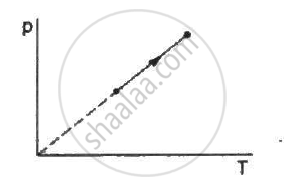
The process on an ideal gas, shown in figure, is
The temperature and pressure at Simla are 15.0°C and 72.0 cm of mercury and at Kalka these are 35.0°C and 76.0 cm of mercury. Find the ratio of air density at Kalka to the air density at Simla.
Use R=8.314J K-1 mol-1
The mean speed of the molecules of a hydrogen sample equals the mean speed of the molecules of a helium sample. Calculate the ratio of the temperature of the hydrogen sample to the temperature of the helium sample.
Use R = 8.314 JK-1 mol-1
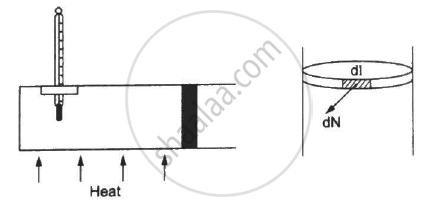
Figure shows a cylindrical tube of radius 5 cm and length 20 cm. It is closed by a tight-fitting cork. The friction coefficient between the cork and the tube is 0.20. The tube contains an ideal gas at a pressure of 1 atm and a temperature of 300 K. The tube is slowly heated and it is found that the cork pops out when the temperature reaches 600 K. Let dN denote the magnitude of the normal contact force exerted by a small length dlof the cork along the periphery (see the figure). Assuming that the temperature of the gas is uniform at any instant, calculate `(dN)/(dt)`.
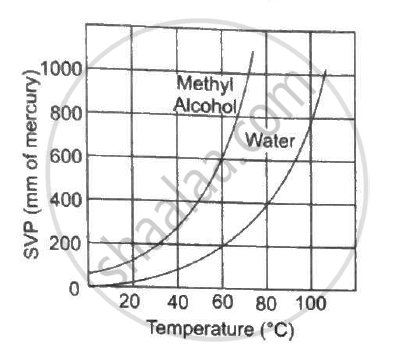
Using figure, find the boiling point of methyl alcohol at 1 atm (760 mm of mercury) and at 0.5 atm.
An adiabatic cylindrical tube of cross-sectional area 1 cm2 is closed at one end and fitted with a piston at the other end. The tube contains 0.03 g of an ideal gas. At 1 atm pressure and at the temperature of the surrounding, the length of the gas column is 40 cm. The piston is suddenly pulled out to double the length of the column. The pressure of the gas falls to 0.355 atm. Find the speed of sound in the gas at atmospheric temperature.
Answer in brief:
A gas in a cylinder is at pressure P. If the masses of all the molecules are made one-third of their original value and their speeds are doubled, then find the resultant pressure.
If the density of oxygen is 1.44 kg/m3 at a pressure of 105 N/m2, find the root mean square velocity of oxygen molecules.
When a gas is heated, its temperature increases. Explain this phenomenon on the basis of the kinetic theory of gases.
Energy is emitted from a hole in an electric furnace at the rate of 20 W when the temperature of the furnace is 727°C. What is the area of the hole? (Take Stefan’s constant σ to be 5.7 × 10⁻⁸ Js-1 m-2K-4.)
The number of degrees of freedom, for the vibrational motion of a polyatomic molecule, depends on the ______
The power radiated by a perfect blackbody depends only on its ______
Calculate the value of λmax for radiation from a body having a surface temperature of 3000 K. (b = 2.897 x 10⁻³ m K)
Under which condition laws of Boyle, Charles, and Gay-Lussac are valid?
If the density of nitrogen is 1.25 kg/m3 at a pressure of 105 Pa, find the root mean square velocity of nitrogen molecules.
A metal cube of length 4 cm radiates heat at the rate of 10 J/s. Find its emissive power at a given temperature.
The average translational kinetic energy of gas molecules depends on ____________.
Explain in detail the kinetic interpretation of temperature.
The average K.E. of hydrogen molecules at 27° C is E. The average K.E. at 627° C is ____________.
Assuming the expression for the pressure exerted by the gas on the wall of the container, it can be shown that pressure is ______.
A gas mixture consists of molecules of types A, B and C with masses mA > mB > mC. Rank the three types of molecules in decreasing order of rms speeds.
The Q-value of a nuclear reaction and kinetic energy of the projectile particle, KP are related as ______.
Two gases A and B are at absolute temperatures of 360 K and 420 K, respectively. The ratio of the average kinetic energy of the molecules of gas B to that of gas A is ______.
When a particle oscillates simple harmonically, its kinetic energy varies periodically. If frequency of the particle is n, then the frequency of the kinetic energy is ______.
According to the kinetic theory of gases, at a given temperature, molecules of all gases have the same ______.
If a = 0. 72 and t = 0.04, then the value of r is ______.
At what temperature will therms velocity of a gas be four times its value at STP?
Which of the following materials is diathermanous?
