Advertisements
Advertisements
प्रश्न
One mole of an ideal gas undergoes a process `P = (P_0)/(1+(V/V_0)^2` where `p_0` and `V_0` are constants . Find the temperature of the gas when `V=V_0` .
Advertisements
उत्तर
Given :
`P = (p_0)/(1+(V/V_0)^2`
Multiplying both sides by V, we get
`pV = (p_0V)/(1+(V/V_0)^2)`
`pV = RT` [From eq. (1)]
Now ,
`RT = (p_0V)/(1+(V/V_0)^2)`
`T = 1/R ((p_0V_0)/(1+(V_0/V_0)^2))` [`V=V_0`]
⇒ `T = (p_0V_0)/(2R)`
APPEARS IN
संबंधित प्रश्न
A gas is kept in an enclosure. The pressure of the gas is reduced by pumping out some gas. Will the temperature of the gas decrease by Charles's low?
Is it possible to boil water at room temperature, say 30°C? If we touch a flask containing water boiling at this temperature, will it be hot?
The pressure of an ideal gas is written as \[P = \frac{2E}{3V}\] . Here E refers to
An ideal gas is trapped between a mercury column and the closed-end of a narrow vertical tube of uniform base containing the column. The upper end of the tube is open to the atmosphere. The atmospheric pressure equals 76 cm of mercury. The lengths of the mercury column and the trapped air column are 20 cm and 43 cm respectively. What will be the length of the air column when the tube is tilted slowly in a vertical plane through an angle of 60°? Assume the temperature to remain constant.
Figure shows a cylindrical tube of cross-sectional area A fitted with two frictionless pistons. The pistons are connected to each other by a metallic wire. Initially, the temperature of the gas is T0 and its pressure is p0 which equals the atmospheric pressure. (a) What is the tension in the wire? (b) What will be the tension if the temperature is increased to 2T0 ?

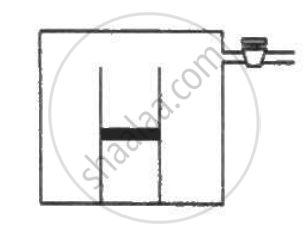
An ideal gas is kept in a long cylindrical vessel fitted with a frictionless piston of cross-sectional area 10 cm2 and weight 1 kg in figure. The vessel itself is kept in a big chamber containing air at atmospheric pressure 100 kPa. The length of the gas column is 20 cm. If the chamber is now completely evacuated by an exhaust pump, what will be the length of the gas column? Assume the temperature to remain constant throughout the process.
An adiabatic cylindrical tube of cross-sectional area 1 cm2 is closed at one end and fitted with a piston at the other end. The tube contains 0.03 g of an ideal gas. At 1 atm pressure and at the temperature of the surrounding, the length of the gas column is 40 cm. The piston is suddenly pulled out to double the length of the column. The pressure of the gas falls to 0.355 atm. Find the speed of sound in the gas at atmospheric temperature.
Answer in brief:
A gas in a cylinder is at pressure P. If the masses of all the molecules are made one-third of their original value and their speeds are doubled, then find the resultant pressure.
When a gas is heated, its temperature increases. Explain this phenomenon on the basis of the kinetic theory of gases.
Find the kinetic energy of 5000 cc of a gas at STP, given the standard pressure is 1.013 × 10⁵ N/m2.
The power radiated by a perfect blackbody depends only on its ______
Why the temperature of all bodies remains constant at room temperature?
Above what temperature, all bodies radiate electromagnetic radiation?
What is the microscopic origin of temperature?
The average translational kinetic energy of a molecule in a gas becomes equal to 0.49 eV at a temperature about (Boltzmann constant = 1.38 x 10⁻²³ JK-1) ____________.
The molecules of a given mass of a gas have root mean square speeds of 100 ms−1 at 27°C and 1.00 atmospheric pressure. What will be the root mean square speeds of the molecules of the gas at 127°C and 2.0 atmospheric pressure?
For a particle moving in vertical circle, the total energy at different positions along the path ______.
If a = 0. 72 and t = 0.04, then the value of r is ______.
At what temperature will therms velocity of a gas be four times its value at STP?
