Advertisements
Advertisements
प्रश्न
Two molecules of a gas have speeds of 9 × 10 6 ms−1 and 1 × 10⁶ ms−1, respectively. What is the root mean square speed of these molecules?
Advertisements
उत्तर
For n-molecules, we know that
`v_(rms) = sqrt((v_1^2 + v_2^2 + v_3^2 + ...... + v_n^2)/n` .....`[(v_(rms) = "root mean"),("square velocity")]`
Where v1, v2, v3 ....... vn are individual velocities of n-molecules of the gas.
For two molecules,
`v_(rms) = sqrt((v_1^2 + v_2^2)/2` ......[v1, v2, v3 ....... vn are individual velocity]
Given, `v_1 = 9 xx 10^6` m/s
And `v_2 = 1 xx 10^6` m/s
∴ `v_(rms) = sqrt(((9 xx 10^6)^2 + (1 xx 10^6)^2)/2`
= `sqrt((81 xx 10^12 + 1 xx 10^12)/2`
= `sqrt(((81 + 1) xx 10^12)/2`
= `sqrt((82 xx 10^12)/2`
= `sqrt(41) xx 10^6` m/s
APPEARS IN
संबंधित प्रश्न
If the molecules were not allowed to collide among themselves, would you expect more evaporation or less evaporation?
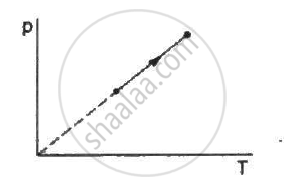
The process on an ideal gas, shown in figure, is
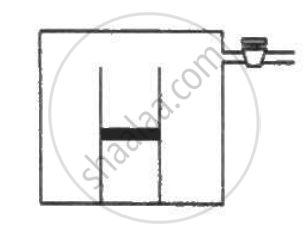
An ideal gas is kept in a long cylindrical vessel fitted with a frictionless piston of cross-sectional area 10 cm2 and weight 1 kg in figure. The vessel itself is kept in a big chamber containing air at atmospheric pressure 100 kPa. The length of the gas column is 20 cm. If the chamber is now completely evacuated by an exhaust pump, what will be the length of the gas column? Assume the temperature to remain constant throughout the process.
The temperature and the dew point in an open room are 20°C and 10°C. If the room temperature drops to 15°C, what will be the new dew point?
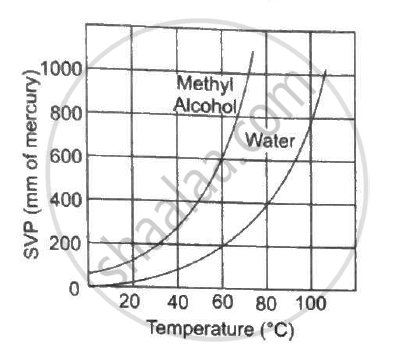
Using figure, find the boiling point of methyl alcohol at 1 atm (760 mm of mercury) and at 0.5 atm.
An adiabatic cylindrical tube of cross-sectional area 1 cm2 is closed at one end and fitted with a piston at the other end. The tube contains 0.03 g of an ideal gas. At 1 atm pressure and at the temperature of the surrounding, the length of the gas column is 40 cm. The piston is suddenly pulled out to double the length of the column. The pressure of the gas falls to 0.355 atm. Find the speed of sound in the gas at atmospheric temperature.
At what temperature will oxygen molecules have same rms speed as helium molecules at S.T.P.? (Molecular masses of oxygen and helium are 32 and 4 respectively).
In an ideal gas, the molecules possess ______.
Explain, on the basis of the kinetic theory of gases, how the pressure of a gas changes if its volume is reduced at a constant temperature.
Energy is emitted from a hole in an electric furnace at the rate of 20 W when the temperature of the furnace is 727°C. What is the area of the hole? (Take Stefan’s constant σ to be 5.7 × 10⁻⁸ Js-1 m-2K-4.)
On what, the values of absorption coefficient, reflection coefficient, and transmission coefficient depend, in addition to the material of the object on which the radiation is an incident?
Why the temperature of all bodies remains constant at room temperature?
The average translational kinetic energy of gas molecules depends on ____________.
Average kinetic energy of H2 molecule at 300K is 'E'. At the same temperature, average kinetic energy of O2 molecule will be ______.
Assuming the expression for the pressure exerted by the gas on the wall of the container, it can be shown that pressure is ______.
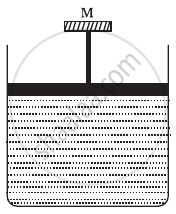
A cylinder containing an ideal gas is in vertical position and has a piston of mass M that is able to move up or down without friction (Figure). If the temperature is increased ______.
A gas mixture consists of molecules of types A, B and C with masses mA > mB > mC. Rank the three types of molecules in decreasing order of rms speeds.
When a particle oscillates simple harmonically, its kinetic energy varies periodically. If frequency of the particle is n, then the frequency of the kinetic energy is ______.
If a = 0. 72 and t = 0.04, then the value of r is ______.
