Advertisements
Advertisements
Question
How will you represent first order reactions graphically.
Advertisements
Solution
i. The differential rate law for the first-order reaction A → P is 
The equation is of the form y = mx + c. A plot of rate versus [A]t is a straight line passing through the origin. The slope of straight line = k.
 |
| Variation of rate with [A] |
ii. The integrated rate law is
k = `2.303/t log_10 ["A"]_0/["A"]_"t"`
On rearrangement, the equation becomes
`(kt)/2.303 = log_10 ["A"]_0 - log_10 ["A"]_"t"`
Hence,
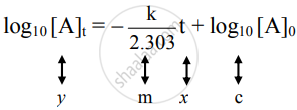
The equation is of the straight line. A graph of `log_10[A]_t` versus t yields a straight line with slope `-"k"/2.303` and y-axis intercepts as log10[A]0.
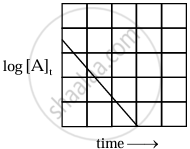 |
| Variation of `log_10 [A]_t` with time |
iii. Rearranging the integrated rate law equation, we get
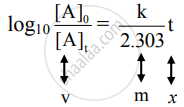
The equation has a straight-line form y = mx. Hence, the graph of `log_10 ([A]_0)/([A]_t)` versus t is a straight line passing through the origin.
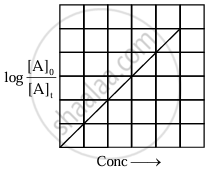 |
| Variation of `log_10 ([A]_0)/([A]_t)` with time |
APPEARS IN
RELATED QUESTIONS
In a first-order reaction, the concentration of the reactant decreases from 20 mmol dm−3 to 8 mmol dm−3 in 38 minutes. What is the half-life of reaction?
Answer the following in brief.
What are the units of the rate constant?
Derive the integrated rate law for the zeroth order reaction.
Rate constant of a reaction is 3.6 × 10⁻³ s–1. The order of reaction is ______.
Write units of rate constants for:
- First-order reaction
- Zero-order reaction
Derive an expression for the relation between half-life and rate constant for first-order reaction.
For a first order reaction \[\ce{A ->Product}\] with initial concentration x mol L−1, has a half life period of 2.5 hours. For the same reaction with initial concentration `("x"/2)` mol L−1 the half life is
Assertion: rate of reaction doubles when the concentration of the reactant is doubles if it is a first-order reaction.
Reason: rate constant also doubles.
A zero order reaction is 20% complete in 20 minutes. Calculate the value of the rate constant. In what time will the reaction be 80% complete?
The integrated rate law is a direct relationship between ____________ and ____________.
A first order reaction is 25% completed in 40 minutes. What is the rate constant k tor the reaction?
The time of completion of 90% of a first order reaction is approximately ____________.
A first order reaction completes its 10% in 20 minutes, then the time required to complete its 19% is ____________.
If [A]0 is the initial concentration, then the half life of zero order reaction is ____________.
The integrated rate equation for first-order reaction, A → product, is ______.
If time required to decrease concentration of reactant from 0.8 M to 0.2 M is 12 hours, the half life of this first order reaction is ____________.
The rate and the rate constants of the reaction, \[\ce{A + 2B -> C + D}\] are 8 × 10⁻³ mol dm−3 s−1 and 2 × 10⁻³ s−1 respectively. The concentrations of A and B are 4 mol dm−3 each. The overall order of the reaction is ____________.
The rate of formation of B at time t for reaction \[\ce{2A -> 3B}\] is equal to ____________.
The half-life of a first order reaction is 6.0 hour. How long will it take for the concentration of reactant to decrease from 0.4 M to 0.12 M?
A first order reaction takes 40 minutes for 30% decomposition. What is the half-life of reaction?
In a reaction \[\ce{N2_{(g)} + 3H2_{(g)} -> 2NH3_{(g)}}\], if the rate of disappearance of N2(g) is 2.6 × 10⁻⁴ M/s, the rate of disappearance of H2(g) in M/s is ____________.
A first order reaction takes 40 minutes for 30% completion. Calculate the half-life of reaction.
A first order reaction, A → B takes 100 minutes for it's 90% completion. What is the rate constant of reaction?
Which is the unit of rate constant for the first-order reaction if time is expressed in seconds?
The integrated rate equation is Rt = log C0 – log Ct, then the straight-line graph is obtained by plotting.
Which among the following reactions is an example of pseudo first order reaction?
Which of the following is correct for a first-order reaction?
The half-life of first order reaction is 1.7 hour. What is its rate constant?
