Advertisements
Advertisements
प्रश्न
How will you represent first order reactions graphically.
Advertisements
उत्तर
i. The differential rate law for the first-order reaction A → P is 
The equation is of the form y = mx + c. A plot of rate versus [A]t is a straight line passing through the origin. The slope of straight line = k.
 |
| Variation of rate with [A] |
ii. The integrated rate law is
k = `2.303/t log_10 ["A"]_0/["A"]_"t"`
On rearrangement, the equation becomes
`(kt)/2.303 = log_10 ["A"]_0 - log_10 ["A"]_"t"`
Hence,
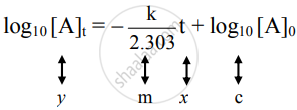
The equation is of the straight line. A graph of `log_10[A]_t` versus t yields a straight line with slope `-"k"/2.303` and y-axis intercepts as log10[A]0.
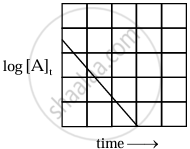 |
| Variation of `log_10 [A]_t` with time |
iii. Rearranging the integrated rate law equation, we get
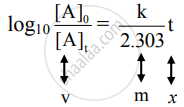
The equation has a straight-line form y = mx. Hence, the graph of `log_10 ([A]_0)/([A]_t)` versus t is a straight line passing through the origin.
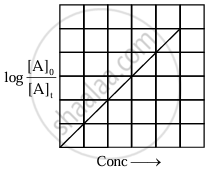 |
| Variation of `log_10 ([A]_0)/([A]_t)` with time |
APPEARS IN
संबंधित प्रश्न
Derive the integrated rate law for the zeroth order reaction.
Time required for 100% completion of a zero order reaction is _______.
For first order reaction, the rate constant for the decomposition of N2O5 is 6 × 10⁻⁴ s –1. The half-life period for decomposition in seconds is ______.
Explain with the help of a potential energy diagram that the catalyst increases the rate of the reaction.
Write units of rate constants for:
- First-order reaction
- Zero-order reaction
A zero-order reaction \[\ce{X -> Product}\], with an initial concentration 0.02 M has a half-life of 10 min. if one starts with concentration 0.04 M, then the half-life is
For a first order reaction \[\ce{A ->Product}\] with initial concentration x mol L−1, has a half life period of 2.5 hours. For the same reaction with initial concentration `("x"/2)` mol L−1 the half life is
For a first-order reaction, the rate constant is 6.909 min−1 the time taken for 75% conversion in minutes is
If 75% of a first order reaction was completed in 60 minutes, 50% of the same reaction under the same conditions would be completed in ____________.
Describe the graphical representation of first order reaction.
The time for half change in a first order decomposition of a substance A is 60 seconds. Calculate the rate constant. How much of A will be left after 180 seconds?
A zero order reaction is 20% complete in 20 minutes. Calculate the value of the rate constant. In what time will the reaction be 80% complete?
How long would it take to electroplate a spoon with 0.1 mol of silver (108 g/mol) at a constant current of 2.0 A using AgNO3?
For first order reaction the concentration of reactant decreases from 0.2 to 0.1 M in 100 minutes. What is the rate constant of the reaction?
The time of completion of 90% of a first order reaction is approximately ____________.
Which among the following reaction is an example of a zero order reaction?
Which of the following represents the expression for `(3/4)^"th"` life of 1st order reaction?
The order of the reaction for which the unit of rate constant is s−1 is ____________.
Half-life period of a first order reaction, \[\ce{A -> product}\] is 3.0 hours. What is the value of rate constant?
Reaction given below follows first order kinetics:
\[\ce{2N2O2 -> 4NO2 + O2}\]
Calculate the rate constant of reaction if concentration of N2O2 is 0.05 M and rate of reaction is 1.5 × 10⁻⁶ mol L−1 s−1?
The slope of a graph, log [A]t versus 't' for a first order reaction is −2.5 × 10⁻³ s−1. The rate constant for the reaction is ____________.
For a zero order reaction, the plot of [A]t vs t is linear. The slope of the line is equal to ____________.
Which among the following is an example of pseudo first order reaction?
The time required to decompose SO2Cl2 to half of it's initial amount is 60 minutes. Calculate rate constant for this first order reaction.
What is the unit of rate constant for the zero order reaction?
Half-life of first-order reaction \[\ce{X -> Y + Z}\] is 3 minutes. What is the time required to reduce the concentration of 'X' by 90 % of it's initial concentration?
The integrated rate equation is Rt = log C0 – log Ct, then the straight-line graph is obtained by plotting.
The half-life of first order reaction is 1.7 hour. What is its rate constant?
Which of the following equations exhibits the integrated rate law equation for first order reaction?
Calculate half life of reaction if rate constant of first order reaction is 0.0178 minute−1.
