Advertisements
Advertisements
Question
Answer the following in brief.
How will you represent the zeroth-order reaction graphically?
Advertisements
Solution
Graphical representation of zero-order reactions: The rate law is given as
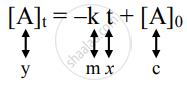
which is a straight line given by y = mx + c.
A plot of `["A"]_"t"` versus t is a straight line.

[A]t vs t for zero-order reaction
The slope of the straight line is -k and its intercept on the y-axis is `["A"]_0`.
APPEARS IN
RELATED QUESTIONS
Answer the following in brief.
Derive the integrated rate law for the first-order reaction,
\[\ce{A_{(g)} -> B_{(g)} + C_{(g)}}\] in terms of pressure.
Answer the following in brief.
What is a zeroth-order reaction?
Solve
The half-life of a first-order reaction is 1.7 hours. How long will it take for 20% of the reactant to react?
Answer the following in brief.
Give one example and explain why it is pseudo-first-order.
Time required for 100% completion of a zero order reaction is _______.
The rate of catalysed reaction is large than the uncatalysed reaction as _______.
For the reaction 2NOBr → 2NO2 + Br2, the rate law is rate = k[NOBr]2. If the rate of a reaction is 6.5 × 10⁻⁶ mol L–1 s–1, when the concentration of NOBr is 2 × 10⁻³ mol L–1. What would be the rate constant of the reaction?
Derive an expression for the relation between half-life and rate constant for first-order reaction.
A zero-order reaction \[\ce{X -> Product}\], with an initial concentration 0.02 M has a half-life of 10 min. if one starts with concentration 0.04 M, then the half-life is
Describe the graphical representation of first order reaction.
Write the rate law for the following reaction.
A reaction that is second order in NO and first order in Br2.
The time for half change in a first order decomposition of a substance A is 60 seconds. Calculate the rate constant. How much of A will be left after 180 seconds?
From the following data, show that the decomposition of hydrogen peroxide is a reaction of the first order:
| t (min) | 0 | 10 | 20 |
| V (ml) | 46.1 | 29.8 | 19.3 |
Where t is the time in minutes and V is the volume of standard KMnO4 solution required for titrating the same volume of the reaction mixture.
What is the value of rate constant of first order reaction, if it takes 15 minutes for consumption of 20% of reactants?
The following reactions follow zero order kinetics, EXCEPT ____________.
A first order reaction has rate constant 1 × 10⁻² s−1. What time will, it take for 20 g or reactant to reduce to 5 g?
Which among the following reaction is an example of a zero order reaction?
In a first order reaction, the concentration of the reactant is reduced to 25% in one hour. The half-life period of the reaction is ____________.
The order of the reaction for which the unit of rate constant is s−1 is ____________.
In the reaction \[\ce{2SO2 + O2 -> 2SO3}\] the rate of appearance of SO3 is 4 × 10⁻⁴ M/s, the rate of disappearance of O2 is ____________.
Which among the following is an example of zero order reaction?
A first order reaction, A → B takes 100 minutes for it's 90% completion. What is the rate constant of reaction?
Which one of the following reactions is a true first-order reaction?
Calculate half-life of a first order reaction in minute if the rate constant is 1 × 10⁻³ s-1.
Consider the following reaction.
\[\ce{SO2(g) + 1/2 O2(g) <=>[K1] SO3(g)}\]
\[\ce{2SO3(g)<=>[K2] 2SO2(g) + O2(g)}\]
What is the relation between K1 and K2?
What are integrated rate laws?
For a first order reaction, the plot of log k against 1/T is a straight line. The slope of the line is equal to ______.
Calculate the time required to decrease the concentration of reactant of first order reaction from 0.8 M to 0.1 M if rate constant is 0.1155 hour−1.
