Advertisements
Advertisements
प्रश्न
Answer the following in brief.
How will you represent the zeroth-order reaction graphically?
Advertisements
उत्तर
Graphical representation of zero-order reactions: The rate law is given as
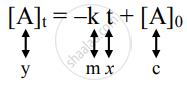
which is a straight line given by y = mx + c.
A plot of `["A"]_"t"` versus t is a straight line.

[A]t vs t for zero-order reaction
The slope of the straight line is -k and its intercept on the y-axis is `["A"]_0`.
APPEARS IN
संबंधित प्रश्न
Answer the following in brief.
Derive the integrated rate law for the first-order reaction.
How will you represent first order reactions graphically.
Answer the following in brief.
Derive the integrated rate law for the first-order reaction,
\[\ce{A_{(g)} -> B_{(g)} + C_{(g)}}\] in terms of pressure.
Derive the integrated rate law for the zeroth order reaction.
Answer the following in brief.
Give one example and explain why it is pseudo-first-order.
For first order reaction, the rate constant for the decomposition of N2O5 is 6 × 10⁻⁴ s –1. The half-life period for decomposition in seconds is ______.
Write a mathematical expression for integrated rate law for zero-order reaction.
For the reaction 2NOBr → 2NO2 + Br2, the rate law is rate = k[NOBr]2. If the rate of a reaction is 6.5 × 10⁻⁶ mol L–1 s–1, when the concentration of NOBr is 2 × 10⁻³ mol L–1. What would be the rate constant of the reaction?
Explain with the help of a potential energy diagram that the catalyst increases the rate of the reaction.
Assertion: rate of reaction doubles when the concentration of the reactant is doubles if it is a first-order reaction.
Reason: rate constant also doubles.
Give two examples for zero order reaction.
A zero order reaction is 20% complete in 20 minutes. Calculate the value of the rate constant. In what time will the reaction be 80% complete?
A first order reaction has a rate constant 0.00813 min-1. How long will it take for 60% completion?
In a first order reaction, the concentration of the reactant, decreases from 0.8 mol dm−3 to 0.4 mol dm−3 in 15 minutes. The time taken for the concentration to change from 0.1 mol dm−3 to 0.025 mol dm−3 is ____________.
What is the order of reaction if the unit of rate constant (k) is mol dm−3 s−1?
If time required to decrease concentration of reactant from 0.8 M to 0.2 M is 12 hours, the half life of this first order reaction is ____________.
For the first order reaction, plot of log10 [A]t against time 't' is a straight line with a negative slope equal to ____________.
Reaction given below follows first order kinetics:
\[\ce{2N2O2 -> 4NO2 + O2}\]
Calculate the rate constant of reaction if concentration of N2O2 is 0.05 M and rate of reaction is 1.5 × 10⁻⁶ mol L−1 s−1?
The time taken for 80% of a first order reaction to be complete is approximately ____________.
The initial concentration of reactant (A) is 2 mol dm−3 for a zero order reaction \[\ce{A -> B}\]. The rate constant (k) is related to its half-life `("t"_(1//2))` by the equation:
In a reaction \[\ce{N2_{(g)} + 3H2_{(g)} -> 2NH3_{(g)}}\], if the rate of disappearance of N2(g) is 2.6 × 10⁻⁴ M/s, the rate of disappearance of H2(g) in M/s is ____________.
Rate constant for zero order reaction is 2 × 10⁻² mol L-1 s-1. If the concentration of the reactant after 25 sec. is 0.5 M, what is the initial concentration of reactant?
Half-life of a first order reaction is 30 minutes and initial concentration of reactant is 0.1 M.
What is half-life of the reaction if initial concentration of reactant is doubled?
A radioactive isotope decayed to 17/32 of its original mass after 60 minutes. Find the half-life of this radioisotope.
What are integrated rate laws?
For a first order reaction, the plot of log k against 1/T is a straight line. The slope of the line is equal to ______.
