Advertisements
Advertisements
प्रश्न
Solve
A first-order reaction takes 40 minutes for 30% decomposition. Calculate its half-life.
Advertisements
उत्तर
Given:
[A]0 = 100%, [A]t = 100 - 30 = 70%, t = 40 min
To find:
Half life of reaction (t1/2)
Formula:
`"k" = 2.303/"t" "log"_10 ["A"]_0/["A"]_"t"`
Calculation:
Substitution of these in above
`"k" = 2.303/"t" "log"_10 100/70`
= `2.303/"40 min" "log"_10 (1.429)`
= `2.303/"40 min" xx 0.155`
= 0.008924 min-1
t1/2 = `0.693/"k" = 0.693/(0.008924 "min"^-1) = 77.66 "min"`
The half life of reaction is 77.66 min.
APPEARS IN
संबंधित प्रश्न
Answer the following in one or two sentences.
How do the half-lives of the first order and zero-order reactions change with the initial concentration of reactants?
Answer the following in brief.
Obtain the relationship between the rate constant and half-life of a first-order reaction.
What are pseudo-first-order reactions?
How will you represent first order reactions graphically.
Answer the following in brief.
Derive the integrated rate law for the first-order reaction,
\[\ce{A_{(g)} -> B_{(g)} + C_{(g)}}\] in terms of pressure.
Answer the following in brief.
What are the units of the rate constant?
Derive the integrated rate law for the zeroth order reaction.
Write order of the following reaction:
\[\ce{2NH_{3(g)} -> N_{2(g)} + 3H_{2(g)}}\]
Write a mathematical expression for integrated rate law for zero-order reaction.
What is half life of first order reaction if time required to decrease concentration of reactants from 0.8 M to 0.2 M is 12 hours?
For the reaction 2NOBr → 2NO2 + Br2, the rate law is rate = k[NOBr]2. If the rate of a reaction is 6.5 × 10⁻⁶ mol L–1 s–1, when the concentration of NOBr is 2 × 10⁻³ mol L–1. What would be the rate constant of the reaction?
The rate constant of the first order reaction is 1.386 min–1. Calculate the time required for 80% reactant to decompose?
For a first-order reaction \[\ce{A -> B}\] the rate constant is x min−1. If the initial concentration of A is 0.01 M, the concentration of A after one hour is given by the expression.
For a first order reaction \[\ce{A ->Product}\] with initial concentration x mol L−1, has a half life period of 2.5 hours. For the same reaction with initial concentration `("x"/2)` mol L−1 the half life is
The decomposition of phosphine (PH3) on tungsten at low pressure is a first-order reaction. It is because the
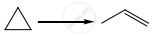
This reaction follows first-order kinetics. The rate constant at particular temperature is 2.303 × 10⁻² hour−1. The initial concentration of cyclopropane is 0.25 M. What will be the concentration of cyclopropane after 1806 minutes? (log 2 = 0.3010)
Assertion: rate of reaction doubles when the concentration of the reactant is doubles if it is a first-order reaction.
Reason: rate constant also doubles.
Write the rate law for the following reaction.
A reaction that is `3/2` order in x and zero order in y.
Write the rate law for the following reaction.
A reaction that is second order in NO and first order in Br2.
How long would it take to electroplate a spoon with 0.1 mol of silver (108 g/mol) at a constant current of 2.0 A using AgNO3?
A first order reaction is 25% completed in 40 minutes. What is the rate constant k tor the reaction?
The time of completion of 90% of a first order reaction is approximately ____________.
In a first order reaction, the concentration of the reactant, decreases from 0.8 mol dm−3 to 0.4 mol dm−3 in 15 minutes. The time taken for the concentration to change from 0.1 mol dm−3 to 0.025 mol dm−3 is ____________.
A first order reaction is 75% completed in 60 minutes, the time required for it's 50% completion is ____________.
The time required to decompose SO2Cl2 to half of it's initial amount is 60 minutes. Calculate rate constant for this first order reaction.
A certain zero order reaction has rate constant 0.025 M s-1. What will be the concentration of reactant 'A' after 15 seconds, if initial concentration is 0.50 M?
The integrated rate law is a direct relationship between time and ______
What is the rate constant of a first order reaction if 0.08 mole of reactant reduces to 0.02 mole in 23.03 minutes?
For a first order reaction, the plot of log k against 1/T is a straight line. The slope of the line is equal to ______.
