Advertisements
Advertisements
Question
Answer the following in brief.
Derive the integrated rate law for the first-order reaction,
\[\ce{A_{(g)} -> B_{(g)} + C_{(g)}}\] in terms of pressure.
Advertisements
Solution
i. For the gas phase reaction,
\[\ce{A_{(g)} -> B_{(g)} + C_{(g)}}\]
Let initial pressure of A be Pi that decreases by x within time t.
ii. Pressure of reactant A at time t
PA = Pi - x ....(1)
The pressures of the products B and C at time t
PB = PC = x
iii. The total pressure at time t is then
P = Pi - x + x + x = Pi + x
Hence, x = P - Pi …(2)
The pressure of A at time t is obtained by substitution of Eq. (1) into Eq. (2).
Thus
PA = Pi - (P - Pi) = Pi - P + Pi = 2Pi - P
iv. The integrated rate law turns out to be
k = `2.303/"t" "log"_10 ["A"]_0/["A"]_"t"`
The concentration is now expressed in terms of pressures.
Thus, [A]0 = Pi and [A]t = PA = 2Pi - P
Substitution gives in above
`"k" = 2.303/"t" "log"_10 "P"_"i"/(2"P"_"i" - "P")` ...(3)
P is the total pressure of the reaction mixture at time t.
APPEARS IN
RELATED QUESTIONS
How will you represent first order reactions graphically.
Answer the following in brief.
What is a zeroth-order reaction?
Answer the following in brief.
What are the units of the rate constant?
For a first-order reaction \[\ce{A -> B}\] the rate constant is x min−1. If the initial concentration of A is 0.01 M, the concentration of A after one hour is given by the expression.
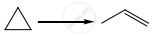
This reaction follows first-order kinetics. The rate constant at particular temperature is 2.303 × 10⁻² hour−1. The initial concentration of cyclopropane is 0.25 M. What will be the concentration of cyclopropane after 1806 minutes? (log 2 = 0.3010)
Describe the graphical representation of first order reaction.
A first order reaction has a rate constant 0.00813 min-1. How long will it take for 60% completion?
The rate of the reaction \[\ce{A + B -> C}\] is 3.6 × 10⁻² mol dm−3 s−1 when [A] = 0.3 mol dm−3 and [B] = 0.2 mol dm−3. Calculate k if reaction is first order in A and zero order in B.
What is the order of reaction if the unit of rate constant (k) is mol dm−3 s−1?
If time required to decrease concentration of reactant from 0.8 M to 0.2 M is 12 hours, the half life of this first order reaction is ____________.
For the first order reaction, plot of log10 [A]t against time 't' is a straight line with a negative slope equal to ____________.
A first order reaction is 75% completed in 60 minutes, the time required for it's 50% completion is ____________.
The half-life of a first order reaction is 6.0 hour. How long will it take for the concentration of reactant to decrease from 0.4 M to 0.12 M?
The time required to decompose SO2Cl2 to half of it's initial amount is 60 minutes. Calculate rate constant for this first order reaction.
A certain zero order reaction has rate constant 0.025 M s-1. What will be the concentration of reactant 'A' after 15 seconds, if initial concentration is 0.50 M?
What is the unit of rate constant for the zero order reaction?
Half-life of first-order reaction \[\ce{X -> Y + Z}\] is 3 minutes. What is the time required to reduce the concentration of 'X' by 90 % of it's initial concentration?
Which is the unit of rate constant for the first-order reaction if time is expressed in seconds?
The integrated rate equation is Rt = log C0 – log Ct, then the straight-line graph is obtained by plotting.
The integrated rate law is a direct relationship between time and ______
Define the half-life of a first-order reaction.
The rate constant and half-life of a first order reaction are related to each other as ______.
Which among the following reactions is an example of pseudo first order reaction?
The rate constant for a first order reaction is 7.0 × 10⁻⁴ s-1. If initial concentration of reactant is 0.080 M, what is the half-life of reaction?
Calculate half-life of a first order reaction in minute if the rate constant is 1 × 10⁻³ s-1.
Which is the relation between half life and rate constant for a zero order?
A radioactive isotope decayed to 17/32 of its original mass after 60 minutes. Find the half-life of this radioisotope.
Calculate the time required to decrease the concentration of reactant of first order reaction from 0.8 M to 0.1 M if rate constant is 0.1155 hour−1.
