English

Harmeet Earns Rs.50 000 per Month. He a Budget for His Salary as per the Following Table:Draw a Bar Graph for the Above Data. - Mathematics

Advertisements
Advertisements

Question

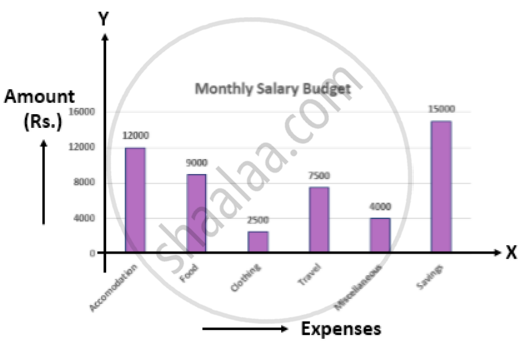
Harmeet earns Rs.50 000 per month. He a budget for his salary as per the following table:

Expenses Accommodation Food Clothing Travel Miscellaneous saving
Amount (Rs.) 12000 9000 2500 7500 4000 15000

Draw a bar graph for the above data.

Graph
Advertisements

Solution

The bar graph is as follows:
shaalaa.com
  Is there an error in this question or solution?
Chapter 23: Graphical Representation of Statistical Data - Exercise 23.1

APPEARS IN

Frank Mathematics [English] Class 9 ICSE
Chapter 23 Graphical Representation of Statistical Data
Exercise 23.1 | Q 1

RELATED QUESTIONS

A random survey of the number of children of various age groups playing in a park was found as follows:

Age (in years) Number of children
1 - 2 5
2 - 3 3
3 - 5 6
5 - 7 12
7 - 10 9
10 - 15 10
15 - 17 4

Draw a histogram to represent the data above.


Study the bar graph representing the number of persons in various age groups in a town shown in Fig. below. Observe the bar graph and answer the following questions:
(i) What is the percentage of the youngest age-group persons over those in the oldest age group?
(ii) What is the total population of the town?

(iii) What is the number of persons in the age group 60 - 65?
(iv) How many persons are more in the age-group 10 - 15 than in the age group 30 - 35?
(v) What is the age-group of exactly 1200 persons living in the town?
(vi) What is the total number of persons living in the town in the age-group 50 - 55?
(vii) What is the total number of persons living in the town in the age-groups 10 - 15 and 60 - 65?

(viii) Whether the population in general increases, decreases or remains constant with the increase in the age-group.


The following bar graph (Fig. 23. 1 4) represents the heights (in cm) of 50 students of Class XI of a particular school. Study the graph and answer the following questions:

(i) What percentage of the total number of students have their heights more than 149cm?
(ii) How many students in the class are in the range of maximum height of the class?
(iii) The school wants to provide a particular type of tonic to each student below the height
of 150 cm to improve his height. If the cost of the tonic for each student comes out to be Rs. 55, how much amount of money is required?
(iv) How many students are in the range of shortest height of the class?
(v) State whether true or false:
a. There are 9 students in the class whose heights are in the range of 155 - 159 cm.
b. Maximum height (in cm) of a student in the class is 17.
c. There are 29 students in the class whose heights are in the range of 145- 154 cm.
d. Minimum height (in cm) of a student is the class is in the range of 140 – 144 cms.
e. The number of students in the class having their heights less than 150 cm is 12.
f. There are 14 students each of whom has height more than 154. cm.


Read the bar graph given in Fig. 23.17 and answer the following questions:
(i) What information is given by the bar graph?
(ii) What was the crop-production of rice in 1970 - 71?
(iii) What is the difference between the maximum and minimum production of rice?


The following bar graph shows the results of an annual examination in a secondary school. Read the bar graph  and choose the correct alternative in each of the following:

(i) The pair of classes in which the results of boys and girls are inversely proportional are:
(a) VI, VIII (b) VI, IX (c) VIII, IX (d) VIII, X
(ii) The class having the lowest failure rate of girls is
(a) VII (b) X (c) IX (d) VIII
(iii)The class having the lowest pass rate of students is
(a) VI (b) VII (c) VIII (d) IX


The following table shows the daily production of T. V. sets in an industry for 7 days of a week:

Day Mon Tue Wed Thurs Fri Sat Sun
Number of T.V. Sets 300 400 150 250 100 350 200

Represent the above information by a pictograph .


In a histogram, each class rectangle is constructed with base as


Draw frequency polygons for each of the following frequency distribution: 

(a) using histogram

(b) without using histogram

C.I

10 - 30

30 - 50

50 - 70 70 - 90 90 - 110 110 - 130 130 - 150
ƒ  4 7 5 9 5 6 4

Mr. Kapoor compares the prices (in Rs.) of different items at two different shops A and B. Examine the following table carefully and represent the data by a double bar graph.

Items Price (in ₹) at the shop A Price (in ₹) at the shop B

Tea-set

900 950

Mixie

700 800

Coffee-maker

600 700

Dinner set

600 500

Following table shows a frequency distribution for the speed of cars passing through at a particular spot on a high way:

Class interval (km/h) Frequency
30 – 40 3
40 – 50 6
50 – 60 25
60 – 70 65
70 – 80 50
80 – 90 28
90 – 100 14

Draw the frequency polygon representing the above data without drawing the histogram.


Share
Notifications

Englishहिंदीमराठी


      Forgot password?
Use app×