Advertisements
Advertisements
Question
Go through the poem and state whether the following statement is true or false.
Planners plan to construct buildings wherever they find a place.
Options
True
False
Advertisements
Solution
Planners plan to construct buildings wherever they find a place - True.
APPEARS IN
RELATED QUESTIONS
B1. Find reasons
(i) The effect of receding forest …………………………………. .
(ii) The number of animals is reduced because ………………………. .
(iii) Elephants entered the city because…………………… .
(iv) Elephants lived a wary life …………………….. .
On the left bank of the Ganga, where it emerges from the Himalayan foothills, there is a long stretch of heavy forest. There are villages on the fringe of the forest, inhabited by bamboo cutters and farmers, but there are few signs of commerce or pilgrimage. Hunters, however, have found the area an ideal hunting ground during the last seventy years, and as a result, the animals are not as numerous as they used to be. The trees, too, have been disappearing slowly; and, as the forest recedes, the animals lose their food and shelter and move further on into the foothills. Slowly, they are being denied the right to live
Only the elephants can cross the river. And two years ago, when a large area of the forest was cleared to make way for a refugee resettlement camp, a herd of elephants - finding their favourite food, the green shoots of the bamboo, in short supply - waded across the river. They crashed through the suburbs of Haridwar, knocked down a factory wall, pulled down several tin roofs, held up a train, and left a trail of devastation in their wake until they found a new home in a new forest which was still untouched. Here, they settled down to a new life but an unsettled, wary life. They did not know when men would appear again, with tractors,bulldozers and dynamite.
B2. Find out
Mention four things the elephants did when they found shortage of food:
(i)………………
(ii)………
(iii) …………
(iv) ………….
B3.Phrases
Make meaningful sentences by selecting any two of the following phrases:
(i) to make way for
(ii) in short
(iii) on the fringe of.
B4. Language study
Select the proper alternative to make the correct voice:
(i) Hunters have found an ideal hunting ground.
-An ideal hunting ground ........found by hunters. (had been, has been, was)
(ii) They are being denied the right to live.
- The people ........them the right to live. (are denying, were denying, denying)
B5.Personal response
What would be your contribution to protect the natural habitat of animals?
Read the passage carefully.
1. I remember my childhood as being generally happy and can recall experiencing some of the most carefree times of my life. But I can also remember, even more vividly, moments of being deeply frightened. As a child, I was truly terrified of the dark and getting lost. These fears were very real and caused me some extremely uncomfortable moments.
2. Maybe it was the strange way things looked and sounded in my familiar room at night that scared me so much. There was never total darkness, but a street light or passing car lights made clothes hung over a chair take on the shape of an unknown beast. Out of the corner of my eye, I saw curtains move when there was no breeze. A tiny creak in the floor would sound a hundred times louder than in the daylight and my imagination would take over, creating burglars and monsters. Darkness always made me feel helpless. My heart would pound and I would lie very still so that 'the enemy' wouldn't discover me.
3. Another childhood fear of mine was that I would get lost, especially on the way home from school. Every morning, I got on the school bus right near my home ‒ that was no problem. After school, though, when all the buses were lined up along the curve, I was terrified that I would get on the wrong one and be taken to some unfamiliar neighbourhood. I would scan the bus for the faces of my friends, make sure that the bus driver was the same one that had been there in the morning, and even then ask the others over and over again to be sure I was in the right bus. On school or family trips to an amusement park or a museum, I wouldn't let the leaders out of my sight. And of course, I was never very adventurous when it came to taking walks or hikes because I would go only where I was sure I would never get lost.
4. Perhaps, one of the worst fears I had as a child was that of not being liked or accepted by others. First of all, I was quite shy. Secondly, I worried constantly about my looks, thinking people wouldn't like me because I was too fat or wore braces. I tried to wear 'the right clothes' and had intense arguments with my mother over the importance of wearing flats instead of saddled shoes to school. Being popular was very important to me then and the fear of not being liked was a powerful one.
5. One of the processes of evolving from a child to an adult is being able to recognise and overcome our fears. I have learnt that darkness does not have to take on a life of its own, that others can help me when I am lost and that friendliness and sincerity will encourage people to like me. Understanding the things that scared us as children helps to cope with our lives as adults.
(a) On the basis of your reading of the above passage, make notes using headings and subheadings. Use recognizable abbreviations wherever necessary.
(b) Make a summary of the passage in not more than 80 words using the notes made and also suggest a suitable title.
What do elephants do to prevent water from evaporating ?
On the basis of your understanding of the above passage, make notes on it using headings and subheadings. Use recognizable abbreviations (wherever necessary – minimum four) and a format you consider suitable. Also supply an appropriate title to it.
Distinguish between the following pairs of words
| Incredulous | - | Incredible |
| Suspicious | - | Susceptible |
| Sensitivity | - | Sentimentality |
| Successive | - | Successful |
'He is free to play the flute all day as well-fed tigers and fat sheep drink from the same pond
with a full stomach for a common bond.'
What do the phrases 'play the flute all day' and 'a common bond' refer to?
Read the following statement and mark those that apply to you.
I have cordial relationships with all but I cannot connect with anyone.
Think, choose and fill up the labels with what a 'sunrise' symbolizes.
(jewellery / art / hope / birth / anger / new opportunities / good manners / inspiration / new achievements / happiness / misery / bright moments / new aims / money / new surprises)

Read the story and complete the following.
At first, Revathi’s plants did not look normal and healthy because, ____________.
Make a list of the preparations made for an assault on Tiger Hill.
Individual guns ___________.
Find evidence from the lesson and write in your own words.
In Israel, the media have a positive outlook and self-respect.
In Gujarat, the kite - festival is celebrated to welcome the Spring.
Think and answer in your own words.
Which line proves that in our busy lives we do not even have a fraction of a second to enjoy nature’s beauty?
Read different stories about intelligent ministers of kings, whose judgments helped to bring about law and order in society. For example - Birbal, Tenalirama, etc. Write 5 such stories in your notebook.
Proverbs associated with the word season: for eg: Make hay while the sun shines.
- _________________________
- _________________________
Say the following word aloud and put the stress mark on the stressed syllable.
crea-tures
Fill in the elements that you find in the drama script of ‘A Battle to Baffle.'
Characters:
- Background Scene:
- Crisis:
- Steps taken to resolve the crisis:
- Climax:
- The end:
Birbal thought Akbar was greater than God.
Apart from the children, no other human beings are mentioned in the poem. However, many natural elements are shown to act like persons. Name them and also write what they do.
In each of the following line, spot the sound that is used repeatedly -
- There’s a silver house in the lovely sky.
- As round as a silver crown
- It takes two weeks to build it up. And two to pull it down.
Explain the use of the following property in the development of the play.
Hat
Write about the various wheel-like objects you see at home, in school, and on the road.
Where does the story take place?
An activity:
Speak fast, think faster ! Form groups of 4-6. Discuss each of the following topics. Then each person in the group should choose a topic and speak about it for one minute. Try to say as many sentences as you can in that time.
What may happen...
I may study... A bird may fly into the classroom. The Principal may call me... It may rain... A dog may chase a cat... A king may lose his kingdom... My friend may give me a storybook to read... Mother may make idlis today...’ etc.
Complete the following sentence with reference to the passage:
To this day, we venerate this tree as ____________.
Answer in your own words.
Why does a mother tell Neel about his Grandpa?
Read: ‘Just So Stories’ and ‘The Jungle Book’ by Rudyard Kipling.
Make groups. One person in the group chooses an announcement. Everyone in the group reads that announcement silently but carefully and closes their books. Then that person presents the announcement, changing one of the details in the announcement. Others spot the change. For example, you might say ‘red’ key chain instead of ‘blue’ in the last announcement.
How was Gulliver tied down on the seashore?
Form groups of four or five.
Try to find the answers to the following questions through observation and by talking to your teachers, parents and others. Discuss your answers in the group.
- How is waste generated?
- How is it removed or cleared?
- How can we help in the task of clearing or removing garbage?
Which event in the story tells us that the scarecrow was intelligent?
Write what the goldfish does.
What is the world wide web?
Guess the meaning of dreary.
How did Miranda feel when her father raised the storm to destroy the ship?
Read the incident again and answer the following question.
What is the humour element in the above incident?
Identify the speaker/character.
‘Even though I clearly said no!’
Hamid’s heart sank because the price of the tongs was______for him.
How does the ability to question help us?
The eggs of an Olive Ridley are in the shape and size of a cricket ball.
Identify the speaker/character.
They somehow managed to put him on the platform.
Why did the farmer have to travel far?
Read the events of the story. They are in the wrong order. Put them in the correct order.
| 1. And it charged straight at the cavalry officers on horseback. |
| 2. And so she flew onto the back of the cow. |
| 3. So everybody panicked and made a general rush to safety |
| 4. The startled cow charged off in fear |
| 5. She applied brakes, but was thrown off the cycle. |
| 6. Just then she saw a lone cow in the middle of the road. |
| 7. Finally the cow fell into a ditch and dislodged the girl. |
| 8. The girl cried out in delight as she overtook her brother on her cycle. |
The man didn’t want to get up because he was tired as he wcoas thrown into the ditch.
What were Anandhan and Yazhini watching in the television?
Read scene I of the play carefully and answer the question below.
Who is about to go on a hunt? Do the wolves panic on his arrival? Explain.
It keeps the sack in every little______.
Choose the correct option from the given homophones.
I saw a ______ on the flower.
What did they use as net?
Write the rhyming word.
away
______is next to parents in care.
Moles bite and ______ the earth worms.
The kingdom was situated in the foothills of______.
What will help you say the truth?
______ had made Math easy for Bala.
What is the one thing you will try and improve after reading the story? How?
Although Helen could not hear or see, what kind of girl was she?
Who came to Akbar’s court?
The passage given below is on Kabbadi. Read the passage and complete the activities that follow.
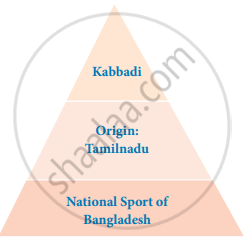
Kabbadi (கபடி - in Tamil) is a contact team sport that originated in Tamil Nadu, India. It is the national sport of Bangladesh. It is also popular in South Asia and is the state game of the Indian states of Tamil Nadu, Kerala, Andhra Pradesh, Bihar, Haryana, Karnataka, Maharashtra, Punjab, and Telangana.

Kabbadi is played between two teams of seven players: the objective of the game is for a single player on offence referred to as a 'raider', to run in to the opposing teams half of a court, tag out as many of their defenders as possible, and return to their own half of the court–all without being tackled by the defenders. Points are scored for each player tagged by the raider, while the opposing team earns a point for stopping the raider. Players are taken out of the game if they are tagged or tackled, but can be 'revived' for each point scored by their team from a tag or tackle. The raider should hold his breath and utter the words like 'kabbadi kabbadi, hututu hututu, chadu kudu' etc. while the opponents try to catch him. If he stops uttering these words, he is considered out.
The game is known by its regional names in different parts of the subcontinent, such as Kabbadi or Chedugudu in Andhra Pradesh, Kabbadi in Kerala and Telangana, Hadudu in Bangladesh, Bhavatik in Maldives, Kauddi or Kabbadi in the Punjab Region, Hu-Tu-Tu in Western India and Hu-Do-Do in Eastern India and Chadakudu in South India. The highest governing body of Kabbadi is the International Kabbadi Federation.
Given below is the visual presentation of the first paragraph.
i) Represent the other paragraphs in a visual form of your choice(flow chart, mind-map, pie-chart, etc.).
ii) Choose the correct option.
1. A contact sport usually involves a ______contact between players.
- violent
- gentle
- physical
2. Kabbadi is a game played between ______.
- seven teams of two players
- two teams of seven players
- four teams of seven players
3. A single ______.
- player on offence is referred to as a raider
- offence is referred to as a raider
- raider is an offence by the player
iii) Answer the following.
- How does a raider score points for his team?
- When does a raider concede a point to the opponent team?
- Can a player be revived when he/she is out of the game? Explain your answer.
- Kabbadi is called by different names in different parts of India. Do you know how Pallankuzhi is called in Karnataka, Andhra Pradesh and Kerala?
