Advertisements
Advertisements
Question
Give two causes and two symptoms of the following:
Antisocial personality disorder.
Advertisements
Solution
Anti-social Personality Disorder- Symptoms- (According to DSM-IV-TR):
A pervasive pattern of disregard for and violation of the rights of others occurring since age 15 years as indicated by atleast three of the following :
- Failure to consider social norms and repeated law breaking.
- Deceitfulness.
- Impulsivity or failure to plan ahead.
- Irritability and aggressiveness.
- Reckless disregard for safety of self or others.
- Consistent irresponsibility.
- Lack of remorse.
Causes :
(i) Biological factors :
Genetic influences: There is moderate heritability for anti-social or criminal behaviour. Researchers found that individuals with low MAO-A activity are more likely to develop Anti-social personality disorder if they had experienced early maltreatment.
Neurological factors: Certain brain areas like temporal lobe and pre-frontal cortex regulate mood and behaviour. Serotonin is the neurotransmitter that can be linked with impulsive and aggressive behaviour.
(ii) Psychosocial factors:
Low fear hypothesis: Research suggests that psychopaths have low trait anxiety and show poor conditioning of fear. They are slow at learning and stop responding in order to avoid punishment.
Emotional deficits: There is a more general difficulty among psychopaths to process and understand the meaning of emotional stimuli. There is a lack of empathy.
Early parental loss, rejection and inconsistency: The aggression is a result of damaging effects of parental rejection, abuse and neglect accompanied by inconsistent discipline.
APPEARS IN
RELATED QUESTIONS
Answer the following question briefly:
State two characteristics of Generalized Anxiety Disorder.
Answer the following question briefly:
What is meant by the term projection?
Explain the term mood disorder.
In which type of Behavioural Analysis Test, an Individual is instructed to play a role for which he/she is observed?
Read the case given below and answer the questions that follow:
| Rohit owned a restaurant in a small city. During the pandemic 2020, his restaurant remained closed which incurred heavy financial losses for him. The prolonged lockdown also affected his mental state and caused him profound sadness. He isolated himself from his family and friends. |
- Identify the psychological disorder in Rohit.
- Briefly explain any two causes of this psychological disorder.
- Elaborate on any four symptoms of this psychological disorder.
| Therapist: | “In our last session, you told me that you do not like attending any social gathering.” |
| Simran: | “Yes, I do not like to attend such functions and prefer to be alone.” |
| Therapist: | “Why is it so?" |
| Simran: | “When I was young my uncle made fun of me in front of my cousins. Since then, I shy away from social situation. I am very sensitive to criticism, so I prefer being on my own.” |
- Identify the disorder displayed by Simran.
- Briefly discuss any three cause of the disorder displayed by Simran.
Sumit, aged seven years, is often scolded by his teachers as he distracts his classmates. The teachers have to make extra efforts to make him sit in class and pay attention. He disrupts the class by walking around.
- Identify the type of disorder displayed by Sumit.
- Explain any three symptoms of the disorder identified in subpart (a).
| Aditi faces recurring periods of intense emotional swings. In some phases, she feels unusually energised, talks rapidly, and indulges in impulsive activities like excessive spending of money. At other times, she withdraws from social interactions, experiences deep sadness, and finds it challenging to focus or engage in daily activities. |
- List the two stages of the psychological disorder displayed by Aditi. (2)
- Explain any two potential causes of this psychological disorder. (2)
Observe the image given below and answer the question that follow.
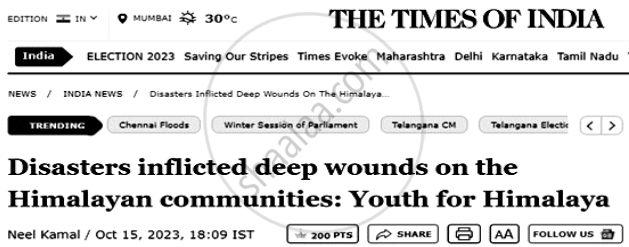
Predict any two possible psychological impact that natural disasters can have on the Himalayan community.
Enuresis is an example of______.
