Advertisements
Advertisements
Question
Observe the image given below and answer the question that follow.
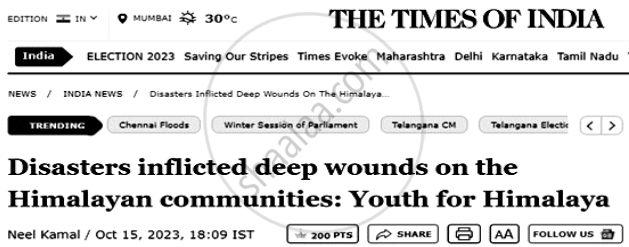
Predict any two possible psychological impact that natural disasters can have on the Himalayan community.
Advertisements
Solution
Possible psychological impact of natural disasters on the Himalayan community:
- They can leave people poverty-stricken and render them homeless without any resources.
- Such a sudden loss of all their belongings as well as their kith and kin can leave people shocked and stunned.
- This may create a deep-seated psychological disorder. It can also lead to post-traumatic stress disorder.
- At the outset, it may cause disorientation.
- It can also lead to certain physical reactions, such as bodily exhaustion even without physical activity, difficulty sleeping, a change in the eating pattern and so on.
- It may also impact their emotional reactions, such as grief and fear, irritability, anger, helplessness, hopelessness, depression, sometimes absolute lack of emotion (numbness), guilt feelings for having survived while someone else in the family died, blaming oneself, and lack of interest in even routine activities.
- It may cause Cognitive reactions such as worry, difficulty in concentration, reduced span of attention, confusion, loss of memory, or vivid memories that are unwanted (or nightmares of the event).
- Social reactions, such as withdrawal from others, getting into conflict with others and feeling rejected or left out.
- These reactions may last for a long time in some cases, throughout life.
APPEARS IN
RELATED QUESTIONS
Answer the following question briefly:
What is meant by the term projection?
Explain the term mood disorder.
A psychological disorder that is characterised by free-floating anxiety is called ______.
| Therapist: | “In our last session, you told me that you do not like attending any social gathering.” |
| Simran: | “Yes, I do not like to attend such functions and prefer to be alone.” |
| Therapist: | “Why is it so?" |
| Simran: | “When I was young my uncle made fun of me in front of my cousins. Since then, I shy away from social situation. I am very sensitive to criticism, so I prefer being on my own.” |
- Identify the disorder displayed by Simran.
- Briefly discuss any three cause of the disorder displayed by Simran.
| Aditi faces recurring periods of intense emotional swings. In some phases, she feels unusually energised, talks rapidly, and indulges in impulsive activities like excessive spending of money. At other times, she withdraws from social interactions, experiences deep sadness, and finds it challenging to focus or engage in daily activities. |
- List the two stages of the psychological disorder displayed by Aditi. (2)
- Explain any two potential causes of this psychological disorder. (2)
Observe the image given below and answer the question that follow.
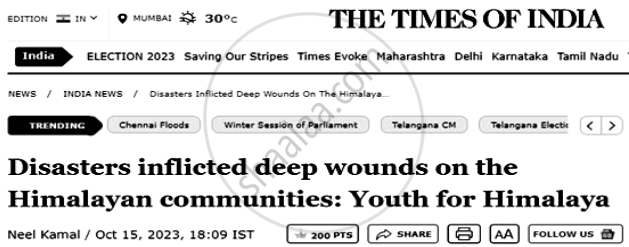
Enumerate any five ways to promote pro-environmental behaviour among people.
Read the passage given below and answer the questions that follow.
|
Fifteen candidates applied for the position of Executive Manager in a private company. The candidates were called individually for a conversation in the first round of recruitment. In the second round, they were given a list of statements on personality factors that they had to rate a scale value for. The final round consisted of a group task in which the candidates were divided into three groups. Each group had to overcome a problem situation given to them. |
- Describe the types of behavioural analysis that were conducted on the candidates in the first and second rounds. (4)
- In your opinion, which type of behavioural analysis would help the directors select the suitable candidate? Justify your answer by giving two reasons. (3)
Behavioural disorders are characterised by behaviours that are______.
Which disorder involves eating non-nutritive substances like paint or sand?
Mental Retardation in DSM categories refers to______.
