Advertisements
Advertisements
Question
Give one example of a decomposition reaction which is carried out with electricity.
Advertisements
Solution
When an electric current is passed through acidified water, it decomposes to give hydrogen gas and oxygen gas. This reaction can be represented as:
\[\ce{\underset{Water}{2H2O_{(l)}} ->[Electricity][(Decomposition)] \underset{Hydrogen}{2H2_{(g)}} + \underset{Oxygen}{O2_{(g)}}}\]
APPEARS IN
RELATED QUESTIONS
Write the balanced chemical equation for the following and identify the type of reaction.
\[\ce{Zinc carbonate(s) -> Zinc oxide(s) + Carbon dioxide(g)}\]
Decomposition reactions require energy either in the form of heat or light or electricity for breaking down the reactants. Write one equation each for decomposition reactions where energy is supplied in the form of heat, light and electricity
What type of reaction is represented by the following equation?
\[\ce{2FeSO4 -> Fe2O3 + SO2 + SO3}\]
What type of reaction is represented by the following equation?
\[\ce{NH4Cl -> NH3 + HCl}\]
What type of chemical reaction takes place when silver bromide is exposed to sunlight?
State the change in colour observed in the following case, mentioning the reason:
Silver chloride is exposed to sunlight.
Which of the following can be decomposed by the action of light?
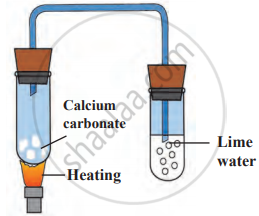
Study the following figure and answer questions.

a) After heating Calcium carbonate, which gas is formed in a test tube?
b) When we pass this gas through limewater what change, did you observe?
c) Write down the chemical reaction showing the product formation after heating the Calcium carbonate.
(a) Design an activity to demonstrate the decomposition reaction of lead nitrate.
(b) Draw labelled diagram of the experimental set-up. List two main observations.
(c) Write balanced chemical equation for the reaction stating the physical state of the reactant and the products.
How can the rate of the chemical reaction, namely, decomposition of hydrogen peroxide be increased?
Answer the following question.
2 g of silver chloride is taken in a china dish and the china dish is placed in sunlight for some time. What will be your observation in this case? Write the chemical reaction involved in the form of a balanced chemical equation. Identify the type of chemical reaction.
Classify the following reaction into –
- Direct combination
- Decomposition
- Displacement
- Double decomposition
The reaction is – Zinc hydroxide on heating gives zinc oxide and water.
Give a balanced equation for the following type of reaction:
A thermal decomposition reaction in which a compound decomposes to give two new compounds.
Differentiate between the following:
Thermal decomposition and thermal dissociation.
Explain the reaction given in the figure.
Photolysis is a decomposition reaction caused by ______
The following reaction is used for the preparation of oxygen gas in the laboratory:
\[\ce{2KClO3_{(s)} ->[Heat] 2KCl + 3O2_{(g)}}\]
Which of the following statement about the reaction is correct?
The reaction of calcium carbonate, with freshly prepared lime water, is shown below:
Answer the questions with the help of a diagram:
- What type of reaction does calcium carbonate undergoes?
- What change in colour is observed in lime?
- Write the chemical equation.

When lead nitrate is heated strongly in a boiling tube, two gases are liberated and a solid residue is left behind in the test tube.
- Name the type of chemical reaction and define it.
- Write the name and formula of the coloured gas liberated.
- Write the balanced chemical equation for the reaction.
- Name the residue left in the test tube and state the method of testing its nature (acidic/basic).
