Advertisements
Advertisements
Question
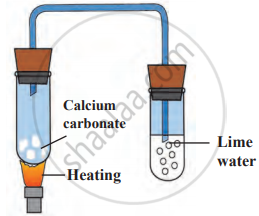
Explain the reaction given in the figure.
Advertisements
Solution
- Calcium carbonate undergoes a decomposition reaction in the first test tube forming calcium oxide powder and carbon dioxide gas.
\[\ce{\underset{\text{Limestone}}{CaCO_{3(s)}} ->[\Delta] \underset{\text{Calcium oxide}}{CaO_{(s)}} + \underset{\text{Carbon dioxide}}{CO2\uparrow}}\] - Carbon dioxide gas formed in the first test tube turns the lime water milky in the second test tube due to the formation of calcium carbonate, which is insoluble in water.
\[\ce{\underset{\text{Calcium hydroxide}}{Ca(OH)_{2(aq)}} + \underset{\text{Carbon dioxide}}{CO_{2(g)}} -> \underset{\text{Calcium carbonate}}{CaCO_{3(s)}} + \underset{\text{Water}}{H2O_{(l)}}}\] - The calcium oxide powder, remains behind in the first test tube.
RELATED QUESTIONS
Write the balanced chemical equation for the following and identify the type of reaction.
\[\ce{Zinc carbonate(s) -> Zinc oxide(s) + Carbon dioxide(g)}\]
A solid substance P which is very hard is used in the construction of many buildings, especially flooring. When substance P is heated strongly, it decomposes to form another solid Q and a gas R is given out. Solid Q reacts with water with the release of a lot of heat to form a substance S. When gas R is passed into a clear solution of substance S, then a white precipitate of substance T is formed. The substance T has the same chemical composition as starting substance P.
- What is substance P? Write its common name as well as chemical formula.
- What is substance Q?
- What is gas R?
- What is substance S? What is its clear solution known as?
- What is substance T? Name any two natural forms in which substance T occurs in nature.
Give one example of a decomposition reaction which is carried out with electricity.
What type of reaction is represented by the following equation?
\[\ce{CaCO3 -> CaO + CO2}\]
What type of chemical reaction takes place when electricity is passed through water?
What type of chemical reaction is represented by the following equation?
\[\ce{X -> Y + Z}\]
What type of reaction is represented by the following equation?
\[\ce{NH4NO2 -> N2 + 2H2O}\]
What is the colour of ferrous sulphate crystals? How does this colour change after heating?
Name the product formed on strongly heating ferrous sulphate crystals. What type of chemical reaction occurs in this change?
State the change in colour observed in the following case, mentioning the reason:
Silver chloride is exposed to sunlight.
Which of the following can be decomposed by the action of light?
When a green iron salt is heated strongly, its colour finally changes to brown and odour of burning sulphur is given out.
- Name the iron salt.
- Name the type of reaction that takes place during the heating of iron salt.
- Write a chemical equation for the reaction involved.
A metal salt MX when exposed to light splits up to form metal M and a gas X2. Metal M is used in making ornaments whereas gas X2 is used in making bleaching powder. The salt MX is itself used in black and white photography.
- What do you think metal M is?
- What could be gas X2?
- Name the metal salt MX.
- Name any two salt solutions which on mixing together can produce a precipitate of salt MX.
- What type of chemical reaction takes place when salt MX is exposed to light? Write the equation of the reaction.
Classify the following reaction as combination, decomposition, displacement, precipitation and neutralization. Also balance the equation.
\[\ce{Zn_{(s)} + H2SO4 -> ZnSO4_{(s)} + H2_{(g)}}\]
What does one mean by endothermic reaction? Give example.
Give a scientific reason.
When the gas formed on heating limestone is passed through freshly prepared lime water, the lime water turns milky.
Study the following figure and answer questions.

a) After heating Calcium carbonate, which gas is formed in a test tube?
b) When we pass this gas through limewater what change, did you observe?
c) Write down the chemical reaction showing the product formation after heating the Calcium carbonate.
(a) Design an activity to demonstrate the decomposition reaction of lead nitrate.
(b) Draw labelled diagram of the experimental set-up. List two main observations.
(c) Write balanced chemical equation for the reaction stating the physical state of the reactant and the products.
Differentiate between direct combination reaction and a decomposition reaction.
Classify the following reaction into –
- Direct combination
- Decomposition
- Displacement
- Double decomposition
The reaction is – Zinc hydroxide on heating gives zinc oxide and water.
Give a balanced equation for –
A thermal decomposition reaction involving heat on limestone [calcium carbonate]
Give a balanced equation for –
An electrolytic decomposition reaction involving a neutral liquid
Give a balanced equation for –
A double decomposition neutralization reaction involving an acid and a base
Give a balanced equation for the following type of reaction:
A thermal decomposition reaction in which a metallic nitrate decomposes to give – a basic oxide.
Differentiate between the following:
Electrolytic decomposition and photochemical decomposition.
What is electrolysis?
Photolysis is a decomposition reaction caused by ______
Electrolysis of water is a decomposition reaction. The mole ratio of hydrogen and oxygen gases liberated during electrolysis of water is:
Marble statues are corroded or stained rain water. Identify the main reason.

Balance the following chemical equation and identify the type of chemical reaction.
`"HgO"("s") overset("(heat)")(->) "Hg"("l") + "O"_2("g")`
The reaction of calcium carbonate, with freshly prepared lime water, is shown below:
Answer the questions with the help of a diagram:
- What type of reaction does calcium carbonate undergoes?
- What change in colour is observed in lime?
- Write the chemical equation.

A solution of a substance ‘X’ is used for whitewashing.
- Name the substance ‘X’ and write its formula.
- Write the reaction of the substance ‘X’ named in the above formula with water.
