Advertisements
Advertisements
Question
Give the meanings of the important terms used in toposheets.
Advertisements
Solution
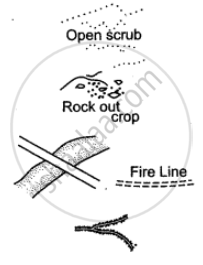
Open Scrub: It is the land where nothing grows. It is a sign of desert area. It indicates occupation as sheep or goat rearing.
Rock Outcrop: It is an exposed part of rock. Cultivation is not possible.
Sheet Rock: It is a mass or slab of rock, a portion of which is exposed above the surface. Shown in white it is also printed so.
Fire Line: A clearing is made in the forest to check the spread of fire.
Causeway: Causeway is a raised road or platform across a minor stream (not to be confused with a bridge). Its presence indicates areas of scanty or seasonal rainfall. Stream having causeway is motorable during dry season.
Broken Ground: It is the weathered part of the land caused due to erosion during heavy rain at the time of flooding. It is found mostly in dry regions around streams and rivers. On toposheet it is shown by tiny curved black line.
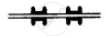
Aqueduct: It is a channel through which water flows.
Quarry: It is a pit from which limestone, marble, rock, sand or clay is obtained for building or other purposes.
Lime Kiln: It is a plant for manufacturing lime. Lime is used for making mortar which is used in holding bricks together.
Dry Well: The word ‘dry’ written in brackets near a well denotes a well that is dry in the dry season.
Brackish Well: The word ‘brackish’ written in brackets near a well means that the water in the well has a high salt content and is not fit for drinking. May be used for irrigation.
RELATED QUESTIONS
Give the four figure grid reference of the settlement of Hamirpura.
Name two natural features in 0527.
Name the types of drainage pattern found in grid square 9374.
Name two relief features that can be seen in grid square 9782 and 9574.
Describe the importance of colours on the toposheet?
The area is measured by grid square method?
The distance is measured on the topographic map. There are two methods of measuring distance on the toposheets,
(i) Direct-method,
(ii) Indirect method.
Measuring straight distance is a direct method and measuring through a winding course is an indirect method. Explain both the methods.
(i) On a topographical map two stations A and B are situated at height of 500 metres and 100 metres respectively. If the horizontal distance between them is 2 km, calculate the gradient.
(ii) On a topographical map, two places A and B are given. Calculate the gradient between them.
Answer the following questions on the Survey Sheet Number 45 D/10. Eastings 00 to 10; Northings 17 to 28. (Map G)
(a) Give four-figure grid references of the following:
(i) Dhad Talao (ii) Sheet rock in the North-east
(iii) Rock outcrop in the North (iv) Stony waste in the South-east
(v) Open scrub south of Dhad Talao
(b) Give the six-figure grid references of the following:
(i) Police Chowki in village Dantral
(ii) Temple in Bhamra village
(iii) Well with water in settlement Devka
(iv) Spot height 310 near village Jolpur
(v) Tank near Indaria settlement
(c) Give-the direction of the following:
(i) Village Dantral (0324) from Dhann (0723)
(ii) Village Bhamra (0521) from Dhann (0723)
(iii) Village Jolpur (0718) from Malawa (0519)
(iv) Village Warka (0716) from Bikanwas (0316)
(v) Village Rampura (0617) from Dhann (0723)
(d) Give the meanings of the following:
(i) 15r in blue in grid square 0224.
(ii) 300 in brown in grid square 0426.
(iii) Black line in the northernmost part of the map.
(iv) Red line in grid square 0819.
(v) Black dots in grid square 0617.
(e) Give the settlement patterns of the following:
(i) Village Dhann (ii) In grid square 0220
(f) Measure the distances of the following:
(i) Direct distance in km. from Indaria (0826) to Jolpur (0718)
(ii) Indirect distance in km. along the cart track from Dantral (0324) to Dhann (0723)
(g) Give the drainage patterns of the following:
(i) 0827 (ii) In grid square 0226
(h) Name three man-made features found in grid square 0419 and draw their symbols.
(i) Give two evidences that the region gets seasonal rainfall.
(j) Explain the nature of the river.
(k) Explain the relief of the area.
(l) What is the general slope of the land? Give reason for your answer.
(m) What is the main occupation of the people? Give reason for your answer.
(n) What is the mode of irrigation? Give reasons for your answer.
(o) What is the mode of transport? Give reasons for your answer.
Write short note on ‘Marginal Information’ in Topographical sheets.
