Advertisements
Advertisements
Question
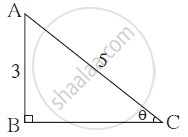
From the figure find the value of sinθ.
Advertisements
Solution
`sinθ = ("AB")/("AC")`
`sinθ = 3/5`
APPEARS IN
RELATED QUESTIONS
Prove the following identities, where the angles involved are acute angles for which the expressions are defined:
`sqrt((1+sinA)/(1-sinA)) = secA + tanA`
Prove the following trigonometric identities:
sin2 A cot2 A + cos2 A tan2 A = 1
Prove the following trigonometric identities.
`cot theta - tan theta = (2 cos^2 theta - 1)/(sin theta cos theta)`
Prove the following identities:
`sinA/(1 + cosA) = cosec A - cot A`
If m = a sec A + b tan A and n = a tan A + b sec A, then prove that : m2 – n2 = a2 – b2
Show that : tan 10° tan 15° tan 75° tan 80° = 1
Prove the following identities:
`cot^2A((secA - 1)/(1 + sinA)) + sec^2A((sinA - 1)/(1 + secA)) = 0`
`cot theta/((cosec theta + 1) )+ ((cosec theta +1 ))/ cot theta = 2 sec theta `
Prove the following identities:
`(1 + tan theta + cot theta)(sin theta - cos theta) = ((sec theta)/("cosec"^2 theta) - ("cosec" theta)/(sec^2 theta))`
What is the value of (1 − cos2 θ) cosec2 θ?
If sec2 θ (1 + sin θ) (1 − sin θ) = k, then find the value of k.
\[\frac{\tan \theta}{\sec \theta - 1} + \frac{\tan \theta}{\sec \theta + 1}\] is equal to
Prove the following identity :
`(1 + sinA)/(1 - sinA) = (cosecA + 1)/(cosecA - 1)`
Prove the following identity :
`sqrt((1 + sinq)/(1 - sinq)) + sqrt((1- sinq)/(1 + sinq))` = 2secq
Verify that the points A(–2, 2), B(2, 2) and C(2, 7) are the vertices of a right-angled triangle.
Prove that `(cot "A" + "cosec A" - 1)/(cot "A" - "cosec A" + 1) = (1 + cos "A")/sin "A"`
If sin θ (1 + sin2 θ) = cos2 θ, then prove that cos6 θ – 4 cos4 θ + 8 cos2 θ = 4
Prove that sec2θ – cos2θ = tan2θ + sin2θ.
If 1 + sin2θ = 3 sin θ cos θ, then prove that tan θ = 1 or `1/2`.
Which of the following is true for all values of θ (0° ≤ θ ≤ 90°)?
