Advertisements
Advertisements
प्रश्न
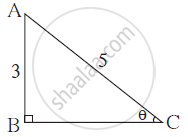
From the figure find the value of sinθ.
Advertisements
उत्तर
`sinθ = ("AB")/("AC")`
`sinθ = 3/5`
APPEARS IN
संबंधित प्रश्न
(1 + tan θ + sec θ) (1 + cot θ − cosec θ) = ______.
Prove the following trigonometric identities.
`(cot A - cos A)/(cot A + cos A) = (cosec A - 1)/(cosec A + 1)`
Prove the following trigonometric identities.
`(tan^2 A)/(1 + tan^2 A) + (cot^2 A)/(1 + cot^2 A) = 1`
Prove the following trigonometric identities.
(sec A + tan A − 1) (sec A − tan A + 1) = 2 tan A
Prove the following trigonometric identities.
If cos A + cos2 A = 1, prove that sin2 A + sin4 A = 1
If sec A + tan A = p, show that:
`sin A = (p^2 - 1)/(p^2 + 1)`
Prove that:
cos A (1 + cot A) + sin A (1 + tan A) = sec A + cosec A
(i)` (1-cos^2 theta )cosec^2theta = 1`
Prove the following identities:
`(1 + cos theta - sin^2 theta )/(sin theta (1 + cos theta)) = cot theta`
If `sin theta = x , " write the value of cot "theta .`
If tanθ `= 3/4` then find the value of secθ.
If x = a sin θ and y = b cos θ, what is the value of b2x2 + a2y2?
(cosec θ − sin θ) (sec θ − cos θ) (tan θ + cot θ) is equal to
Prove the following identity :
( 1 + cotθ - cosecθ) ( 1 + tanθ + secθ)
Prove the following identity :
`(cosecA - sinA)(secA - cosA)(tanA + cotA) = 1`
If x = asecθ + btanθ and y = atanθ + bsecθ , prove that `x^2 - y^2 = a^2 - b^2`
Find the value of sin 30° + cos 60°.
Evaluate:
`(tan 65^circ)/(cot 25^circ)`
Prove the following identities:
`1/(sin θ + cos θ) + 1/(sin θ - cos θ) = (2sin θ)/(1 - 2 cos^2 θ)`.
Prove the following identity:
(sin2θ – 1)(tan2θ + 1) + 1 = 0
