English

Form a Differential Equation Representing the Given Family of Curves by Eliminating Arbitrary Constants a and B. Y = a E3x + B E– 2x - Mathematics

Advertisements
Advertisements

Question

Form a differential equation representing the given family of curves by eliminating arbitrary constants a and b.

y = a e3x + b e– 2x

Advertisements

Solution
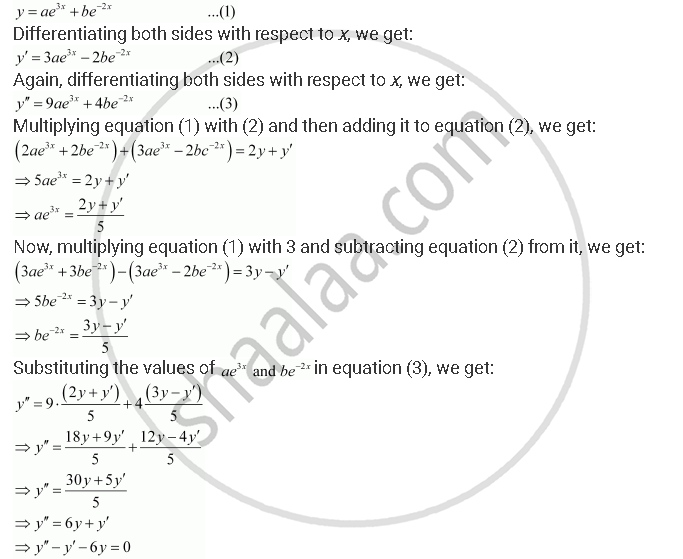
This is the required differential equation of the given curve.

shaalaa.com
  Is there an error in this question or solution?
Chapter 9: Differential Equations - Exercise 9.3 [Page 391]

APPEARS IN

NCERT Mathematics Part 1 and 2 [English] Class 12
Chapter 9 Differential Equations
Exercise 9.3 | Q 3 | Page 391

RELATED QUESTIONS

Write the integrating factor of the following differential equation:

(1+y2) dx(tan1 yx) dy=0


Find the differential equation of the family of lines passing through the origin.


Find the particular solution of the differential equation (1 + e2x) dy + (1 + y2) ex dx = 0, given that y = 1 when x = 0.


Find the differential equation representing the family of curves `y = ae^(bx + 5)`. where a and b are arbitrary constants.


Form the differential equation having \[y = \left( \sin^{- 1} x \right)^2 + A \cos^{- 1} x + B\], where A and B are arbitrary constants, as its general solution.


The equation of the curve satisfying the differential equation y (x + y3) dx = x (y3 − x) dy and passing through the point (1, 1) is


Show that y = C x + 2C2 is a solution of the differential equation \[2 \left( \frac{dy}{dx} \right)^2 + x\frac{dy}{dx} - y = 0.\]


Show that y2 − x2 − xy = a is a solution of the differential equation \[\left( x - 2y \right)\frac{dy}{dx} + 2x + y = 0.\]


From x2 + y2 + 2ax + 2by + c = 0, derive a differential equation not containing a, b and c.


\[\frac{dy}{dx} = \sin^3 x \cos^4 x + x\sqrt{x + 1}\]


\[\frac{dy}{dx} + 4x = e^x\]


\[\frac{dy}{dx} = x^2 e^x\]


\[\frac{dy}{dx} - x \sin^2 x = \frac{1}{x \log x}\]


\[(\tan^2 x + 2\tan x + 5)\frac{dy}{dx} = 2(1+\tan x)\sec^2x\]


cos y log (sec x + tan x) dx = cos x log (sec y + tan y) dy


cosec x (log y) dy + x2y dx = 0


(1 − x2) dy + xy dx = xy2 dx


A solution of the differential equation `("dy"/"dx")^2 - x "dy"/"dx" + y` = 0 is ______.


Find the general solution of the following differential equation:

`x (dy)/(dx) = y - xsin(y/x)`


The general solution of the differential equation `(dy)/(dx) + x/y` = 0 is


General solution of tan 5θ = cot 2θ is


Solution of the equation 3 tan(θ – 15) = tan(θ + 15) is


The general solution of the differential equation of the type `(dx)/(dy) + p_1y = theta_1` is


The general solution of the differential equation `(ydx - xdy)/y` = 0


Find the general solution of differential equation `(dy)/(dx) = (1 - cosx)/(1 + cosx)`


What is the general solution of differential equation `(dy)/(dx) = sqrt(4 - y^2)  (-2 < y < 2)`


The general solution of the differential equation y dx – x dy = 0 is ______.


The general solution of the differential equation ydx – xdy = 0; (Given x, y > 0), is of the form

(Where 'c' is an arbitrary positive constant of integration)


Share
Notifications

Englishहिंदीमराठी


      Forgot password?
Use app×